
Short answer
A doorbell transformer converts 230 volts to a low voltage, usually 8 or 12 volts, that your doorbell works on. If your doorbell is not working, in order of likelihood it is: the push button, the bell itself, the wiring, and only last the transformer. First measure whether there is voltage coming out of the transformer.
Who this article is for The low-voltage side of a doorbell system is harmless and you can take measurements on it yourself. The 230 volt side, so the connection of the transformer in the consumer unit, is work for an electrician.
What it does
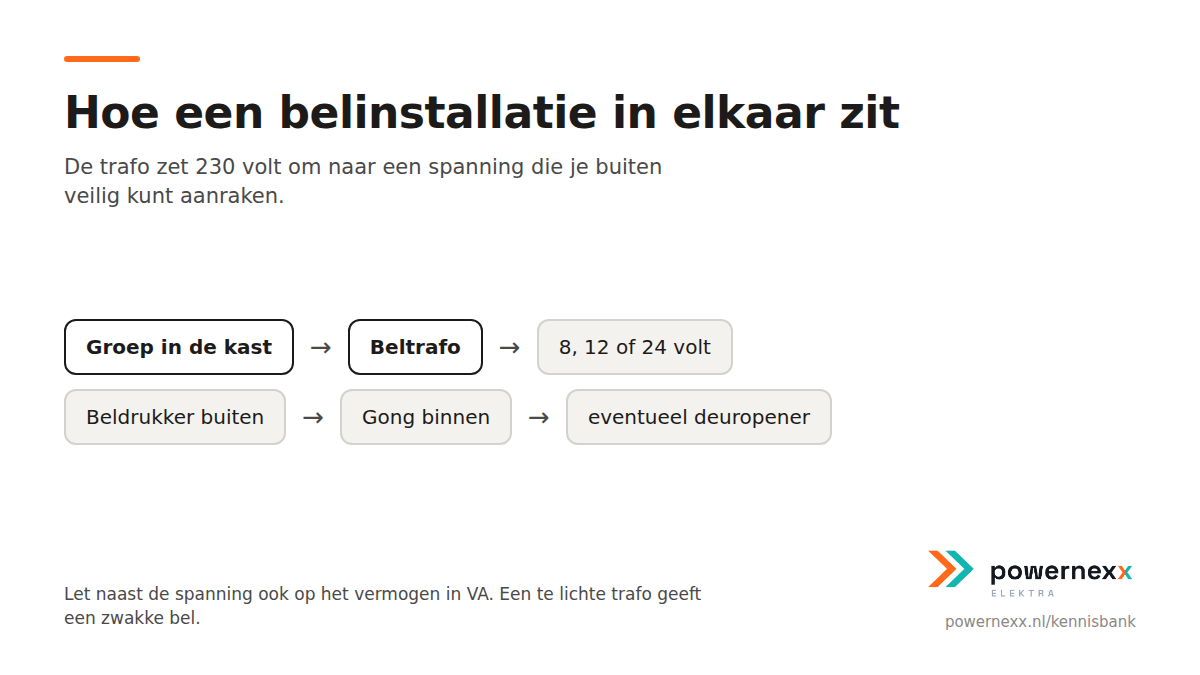
A doorbell does not work on 230 volts. That would be lethal with a push button that anyone outside can touch, often in the rain. That is why there is a transformer in between that converts the mains voltage to a safe low voltage.
Common output voltages:
| Voltage | Typical use |
|---|---|
| 8 V | Classic single-tone bell or chime |
| 12 V | Chimes, some video doorbells, LED lighting at the push button |
| 24 V | Heavier chimes, some intercom systems, door releases |
Besides the voltage, the power is important, expressed in VA. A simple bell needs 4 to 8 VA. A chime with an illuminated push button and a door release draws more. A transformer that is too light gives a bell that sounds weak or a door release that does not click.
Always check what your bell or chime needs before you buy a transformer. That is on the rating plate or in the manual.
Where it sits
In modern installations the doorbell transformer sits on the DIN rail in the consumer unit, usually 1 to 2 modules wide. On one side 230 volts from a circuit, on the other side the low voltage to the push button and the bell.
In older installations it sometimes hangs loose in the meter cupboard, in the hall cupboard or even in the loft. That is one of the reasons people cannot find it when the doorbell is not working.
Tip: note on the circuit chart where the doorbell transformer is. That saves searching next time.
Your doorbell is not working: how to find the fault
Go in this order. Most faults are at point 1 or 2.
1. The push button. By far the most common cause. It is outside and gets rain, frost and fingers. The contacts corrode or the spring breaks. Take the button off the wall and briefly hold the two wires together. Does the bell ring? Then the push button is broken. A new one costs a few euros.
2. The bell or chime itself. A mechanical chime can jam because of dust or because someone once knocked into it. An electronic chime can simply be broken.
3. The wiring. Doorbell wire is thin and is often run loose along skirting boards or behind door frames. A screw through the wire during a job is a classic. Check the continuity with a multimeter.
4. The transformer. Measure on AC voltage with a multimeter at the low-voltage side. Is there 8 or 12 volts? Then the transformer is working. If there is nothing, the transformer is broken or it is not getting 230 volts.
5. The circuit the transformer is on. Sometimes it is simply the breaker that has tripped, or the transformer is on a circuit that has been switched off for another reason. If a whole circuit is off, see RCD keeps tripping.

Replacing it with a video doorbell
An increasingly common question. Two things to know:
Most video doorbells work on 12 to 24 volts and need considerably more power than a classic bell. Your existing 8 volt, 4 VA transformer will not manage that. So a heavier transformer almost always has to go in.
The existing doorbell wire can sometimes be used. If there are two cores and the distance is limited, you can often reuse them for the power supply. That does not apply to the video signal: with most systems that goes over wifi, and with wired intercom systems over its own cable.
If you want a real video intercom system instead of a consumer doorbell, that is a different story. I regularly do that for owners' associations (VvE) and blocks of flats.
From my own work
At a house in Meerssen the doorbell had not worked for two years. The residents had bought a new chime and that did not work either. The transformer turned out to be fine. In the end the break was in the doorbell wire, exactly where a screw had gone through the frame when a new front door was fitted. Found within ten minutes with a continuity tester.
When to call an electrician
- You have gone through the steps above and the transformer gives no voltage
- You want a video doorbell or intercom and do not know whether your wiring is good enough
- It is a block of flats with a door entry panel and several indoor stations
For owners' associations (VvE) and flats this is my work: I regularly do complete video intercom installations. See also what else I do in electrical installations.
Request a quote, or for an urgent problem go to the fault service.
Frequently asked questions
What voltage does my doorbell need?
Usually 8 or 12 volts AC. Look at the rating plate of the bell or chime. Besides the voltage, the power in VA is important too.
Where is the doorbell transformer?
In modern installations on the DIN rail in the consumer unit. In older homes it can hang loose in the meter cupboard, the hall cupboard or in the loft.
What is the most common cause of a doorbell that does not work?
The push button. It is outside and the contacts corrode. Often a repair costing a few euros.
Can I use my old doorbell transformer for a video doorbell?
Usually not. Video doorbells need a higher voltage and much more power than a classic bell.
Can I replace a doorbell transformer myself?
You may measure and touch the low-voltage side. Connecting the transformer to 230 volts in the consumer unit is work for an electrician.
How many modules does a doorbell transformer take?
Usually 1 to 2 modules on the DIN rail.
Further reading
The intercom is not working: troubleshooting in four steps
If it does not work in one home, the problem is in that home. If it works for nobody, the problem is at the entrance or the power supply.
Intercom in a block of flats: how it is put together
In a block of flats the work is in the riser cable and the door entry panel, not in the handsets. That decides whether replacement turns out easier or harder than expected.
Replacing a doorbell or chime: what to look out for
Check the voltage of your transformer before you buy a chime, and where you will hear it. Those are the two things that go wrong.
Questions and comments
Ask your question below. Ask before 17:00 on a working day and you get an answer from Kevin himself the same day. No account needed, and your email address does not appear on the site.