
Short answer
In the vast majority of cases there is one appliance causing leakage current. With the step-by-step plan below you will find which appliance it is within half an hour, without tools and without unscrewing the consumer unit. Does the RCD also trip when everything is switched off? Then it is in the fixed installation and you need an installer.
What does an RCD actually do
An RCD measures how much current comes into your installation through the live wire and how much comes back through the neutral wire. Normally that is exactly the same. As soon as current leaks away somewhere, for example through a damp casing, through earth or through you, the balance is off. At a difference of 30 milliamps it switches off within a few hundredths of a second.
Thirty milliamps is not much. For comparison: a 60 watt incandescent bulb draws well over 260 milliamps. So the RCD reacts to a fraction of that, and that is exactly the point. It is not there to protect your appliances, it is there to stop you from dying.
That also means something important: an RCD that trips is doing its job. It is not broken because it trips. It trips because something is wrong.
First this: which switch exactly has tripped
Open the door of your meter cupboard and look carefully. There is a difference.
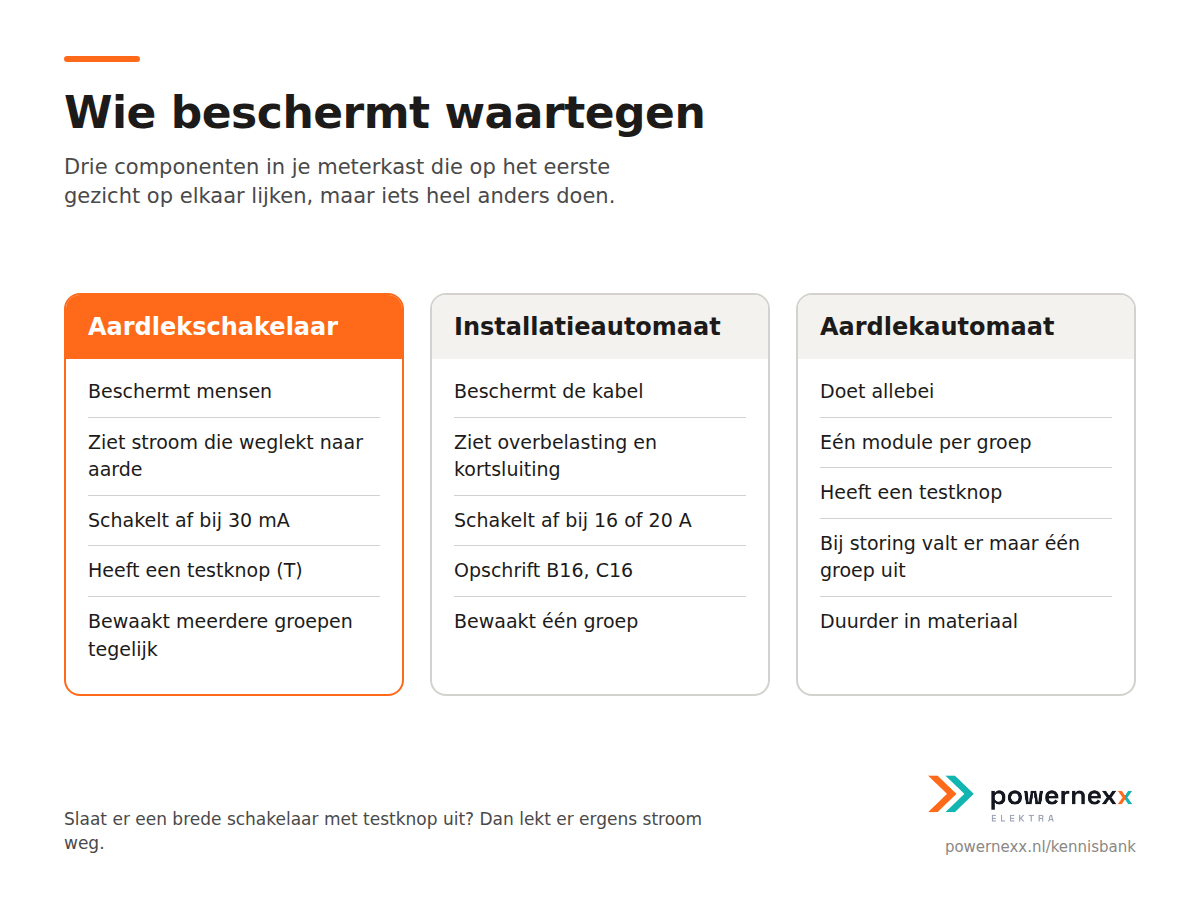
- A wide switch with a test button (T) and several small breakers next to it: that is an RCD. It protects all the circuits behind it, usually three to five.
- A narrow switch with only a number on it (B16, C16): that is a circuit breaker (MCB). It reacts to overload or short circuit, not to leakage current. So something else is going on.
- A narrow switch with a test button: an RCBO. It does both, and the advantage is that you immediately know which circuit it is.
With an RCD a whole block of circuits goes off at once. That is why half your house is dark while only one appliance is faulty.
Not sure which circuit goes where? With my circuit mapper you go through your consumer unit in a few minutes and know which circuit belongs to which room. That saves you a lot of searching at the next fault.
The step-by-step plan
You need nothing for this except a little patience. Leave the cover of the consumer unit closed. You only switch on and off what you can operate by hand.
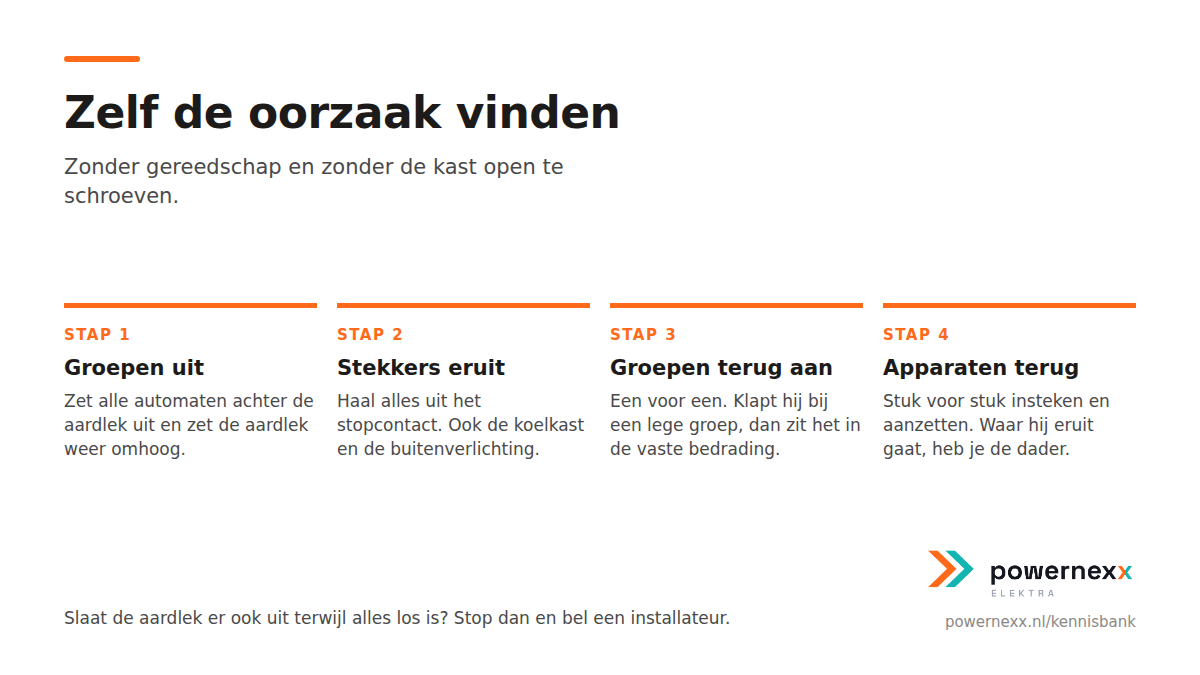
Step 1. Switch off all circuits behind the RCD. First put all the small breakers behind the tripped RCD in the off position. Only then push the RCD itself back up. Does it stay on? Good, then the problem is behind one of the circuits.
Does the RCD trip again straight away while all circuits are off? Then go to the heading "If it also trips with everything off" further down.
Step 2. Pull out the plugs. Go round the rooms behind this RCD and unplug everything. Do not forget: washing machine, dryer, dishwasher, water heater, outdoor lighting, pond pump, aquarium, charger in the garage, and the fridge. Yes, the fridge too.
Step 3. Switch the circuits back on one by one. Switch on the first circuit. Does everything stay on? Next. Does the RCD trip the moment you switch on a particular circuit, while nothing is plugged in? Then the problem is in the fixed wiring or in a hard-wired appliance on that circuit. Note which circuit and stop here.
Step 4. Plug the appliances back in one by one. Are all circuits back on? Then plug the appliances in one at a time, and actually switch them on. Wait a moment with each appliance. The moment the RCD trips, you have found the culprit.
Two things that make the search quicker
Watch the timing. If it always trips around the same time, look for something with a timer: water heater, underfloor heating, a time switch on the garden lighting. If it trips when it rains, look outside.
Watch the heat. Heating elements only leak once they are up to temperature. A washing machine that trips the RCD after twenty minutes is almost always the element. So set the machine to a hot water programme when you test it, not cold.
The suspects, in order of likelihood
After years of fault finding, the top five is surprisingly predictable:
- The washing machine or dryer. Heating elements develop micro-cracks and start leaking as soon as they get warm. Classic symptom: it does not trip straight away, but only twenty minutes into the programme.
- The water heater or geyser. Same story, same element.
- Outdoor lighting or a garden socket. Water in a light fitting or in a junction box. Almost always after a shower of rain or a spell of frost. See also installing outdoor lighting, where I explain why outdoors should have its own circuit.
- A charger or power supply. Cheap adapters, LED drivers and old laptop chargers constantly leak a little. Each appliance is allowed to leak a little, but add ten of them together and you are over 30 milliamps.
- The dishwasher or a built-in appliance. Leaking seal, water on the electronics.
Number 4 is the most annoying, because then there is no single faulty appliance. Everything leaks a little and together they hit the limit. You recognise it because it trips at random, often in the evening when everything is on, and you never find a culprit. The solution is then usually to split the circuits over a second RCD. That can sometimes be done in your existing consumer unit, and otherwise it is part of replacing your consumer unit.
If it also trips with everything off
Does the RCD keep tripping while all circuits are off? Then the problem is between the RCD and the circuits, so in the consumer unit itself. That can be:
- A faulty RCD. It happens, but less often than people think.
- A neutral connection that is wrong somewhere, for example because the neutral of one circuit is connected to the other RCD. That is a classic after a renovation or an earlier extension.
- Damp in the meter cupboard itself, for example with a meter cupboard against an outside wall.
This is the point where you must stop. Behind the cover there is voltage that is still present when all breakers are off, because the supply from the main fuse stays live. Do not unscrew it.
What you must never do
- Jam or bypass the RCD. It still happens. You are removing the only protection that stops leakage current from passing through a person.
- Keep resetting until it happens to stay on. If it trips three times in a row, something really is wrong. Trying again and again only causes wear.
- Replace the RCD because "it is worn out". Only replace it once you have measured that it trips too early or too late. That takes an installer ten minutes with an RCD tester.
Test it yourself, every six months
Every RCD has a test button, usually marked T. Press it while the installation is simply on. The switch should drop out immediately. Then push it back up.
Does nothing happen when you press the test button? Then your RCD no longer works and you currently have no protection against leakage current. That is a reason to have someone come out within a week.
Put it in your diary: twice a year, for example when the clocks change. If you would rather not keep track yourself, that six-monthly check is included in my service plan.
From my own work
On a job in Meerssen the RCD tripped every morning at around seven. The residents had already replaced everything: washing machine, dryer, even the water heater. It turned out to be the underfloor heating in the bathroom, which came on at a quarter to seven via a timer thermostat. The heating mat was leaking at one spot where a screw had once gone through it when a radiator bracket was fitted. Measuring showed it within twenty minutes.
When to call an electrician
- The RCD trips while all circuits are off.
- You have found the culprit, but it is a hard-wired appliance or fixed wiring.
- The test button does nothing.
- You smell burning or see brown discolouration around a connection. Then you call straight away, not tomorrow.
- After the whole step-by-step plan you find nothing and it keeps happening.
I do fault finding with insulation and leakage current measurement. Usually it is clear within an hour. Count on € 85 per hour plus € 59,99 call-out charge, both excluding VAT, wherever you are in the Netherlands. Prices as of August 2026. The full breakdown of that rate is on what an electrician costs.
If it is urgent, just call: +31 43 204 18 26. In case of fire or immediate danger, call 112 first.
Through my fault service you enter your postcode and see straight away when I can be with you. You pick a time slot yourself; you do not have to wait for someone to call back. Prefer to talk it through first? Send a photo of your meter cupboard via WhatsApp and I will tell you what I see.
Frequently asked questions
Can I switch the RCD back on myself?
Yes. Anyone may switch on and off what can be operated by hand. Unscrewing the cover of the consumer unit is not allowed.
Why does it only trip in the morning or only when it rains?
That is a strong clue. If it happens in the morning, that points to a time switch, water heater or underfloor heating. If it happens when it rains, that points to outdoor lighting, a garden socket or a junction box letting in water.
Can an RCD itself break down?
Yes, but less often than people think. The mechanism can seize if it has not been tested for years. Hence the test button.
My RCD has been tripping since I got an EV charger. How come?
Some cars cause a small DC component while charging, and a standard type A RCD does not cope well with that. An EV charger should always have its own circuit with its own RCD protection, see EV charger installation.
How many circuits may be behind one RCD?
The standard allows a maximum of four final circuits per RCD. In older installations you sometimes see six or more, and that is exactly why so much goes off at once in those consumer units.
What does it cost if you come and look?
Hourly rate plus call-out charge. For a standard fault investigation in a home you usually pay between € 145 and € 230 excl. VAT, including a small repair. For bigger repairs you get the price by email beforehand. See what an electrician costs for the full breakdown.
Can I have an inspection done instead of waiting until it goes wrong?
You can. During an electrical inspection of your home I test all circuits and test the RCDs for trip time and trip current. You get a report of it, which you can also show to your insurer.
Further reading
Lights flickering or dimming: what it tells you
Flickering in one light is usually the bulb or the dimmer. Flickering throughout the house is a reason to measure.
The circuit breaker trips: overload or short circuit
A breaker that only trips after a while points to overload. If it trips straight away, it is a short circuit.
Power out in one room: the step-by-step plan
One room without power is almost always one circuit. In four steps you know which one, and what to do if nothing seems to have tripped.
Questions and comments
Ask your question below. Ask before 17:00 on a working day and you get an answer from Kevin himself the same day. No account needed, and your email address does not appear on the site.