
Short answer
Inside the consumer unit you use flexible wire that can take the heat, usually H07V2-K, with ferrules on every end. The cross-section follows the protection: 2.5 mm² at 16A, 4 mm² at 20A, 6 mm² at 25A. The colours are fixed: brown, black or grey for line, blue for neutral, green-yellow for earth.
Who this article is for This is technical background, not DIY instructions. Working in a consumer unit means working right next to a supply that you cannot isolate. Only do this if you are demonstrably competent under NEN 3140. As a homeowner: read along so you understand what your electrician is doing, but leave the work to him.
Which type of wire
A consumer unit gets warm. Components give off heat, the enclosure is closed and there is often little ventilation. That is why you use wire that can cope with it.
H07V2-K is the standard: flexible copper wire with PVC insulation rated up to about 90 degrees. Flexible because you make a lot of tight bends in a consumer unit, and stiff wire then breaks or presses against components.
H07V-U or VD wire (solid) belongs in the fixed installation, in conduit. Not in the consumer unit, because it is too stiff for the bends you make there.
Ferrules are not optional. Flexible wire without a ferrule in a screw terminal means loose strands, poor contact pressure and, in time, heat build-up. Every conductor gets a ferrule, crimped with a good crimping tool, in the colour that matches the cross-section.
Colours
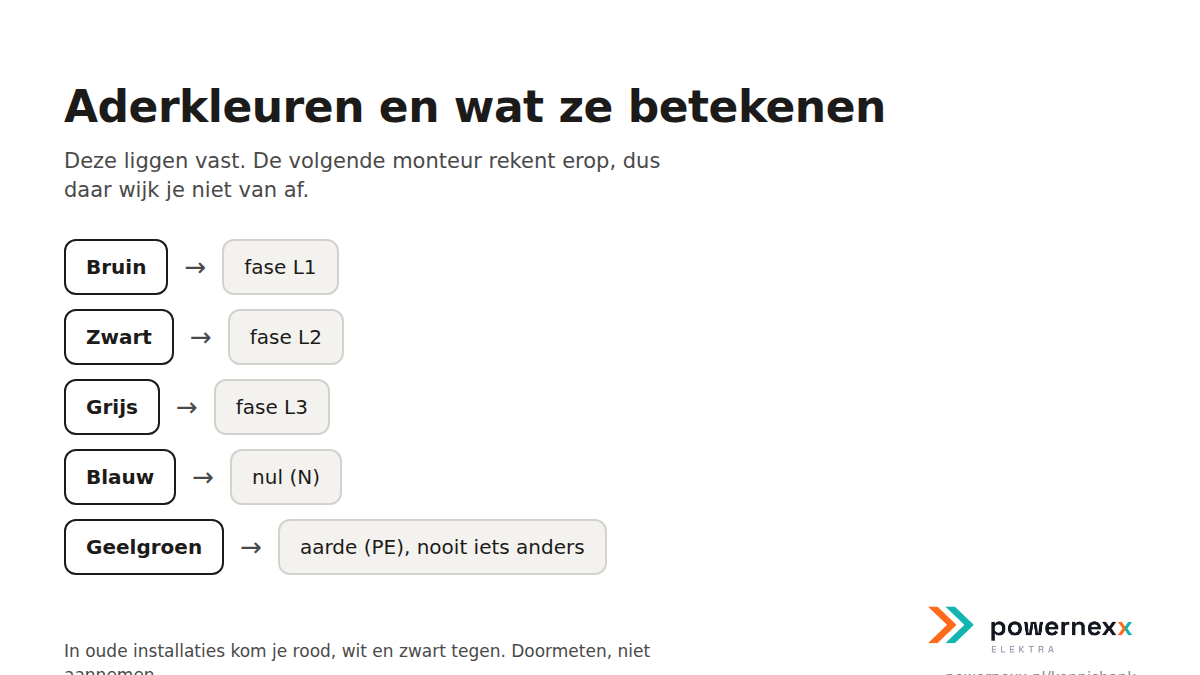
These are fixed and you do not deviate from them, because the next electrician relies on them.
| Colour | Function |
|---|---|
| Brown | Line (L1) |
| Black | Line (L2) |
| Grey | Line (L3) |
| Blue | Neutral (N) |
| Green-yellow | Earth (PE) |
Never use green-yellow for anything else, not even when it happens to be convenient. In principle blue may only be used as neutral.
In older installations you still come across red, white and black from before the European colour code. When replacing a consumer unit that means: measure, do not assume. I have found red wires used as neutral and blue ones as line.
Cross-section: which wire with which breaker
The cross-section follows the protection, not the other way round. The breaker protects the cable, so the cable must be able to carry the current the breaker lets through.
| Breaker | Minimum cross-section in the consumer unit |
|---|---|
| B10 / C10 | 1.5 mm² |
| B16 / C16 | 2.5 mm² |
| B20 / C20 | 4 mm² |
| B25 / C25 | 6 mm² |
| B32 / C32 | 6 to 10 mm² |
| Main switch 40A | 10 mm² |
| Main switch 63A | 16 mm² |
These are guide values for short lengths inside a consumer unit under normal conditions. With a long cable run or with many cables bundled together you have to go up a size because of voltage drop and heat dissipation.
The mistake made most often: fitting a heavier breaker on existing wiring to "solve" an overloaded circuit. If 2.5 mm² is installed and you fit a 20A breaker, the protection no longer trips before the cable gets hot. That is exactly how you end up with a smouldering cable in a wall. The right solution is an extra circuit, see separate circuits.
Working neatly is not about looks
A neatly wired consumer unit looks good, but that is not why it has to be done.
- Bundling and routing makes sure no wire lies against a hot component.
- Leaving space around the components allows air to circulate.
- Spare wire length at each connection means you can replace a component later without pulling everything again.
- Strain relief at the entry makes sure a terminal does not come loose if the cable is pulled.
- Tightening torques as specified by the manufacturer. Too loose causes heat, too tight damages the conductor. This is where most loose connections come from.
That last point is the most underestimated cause of problems in meter cupboards. A terminal tightened by hand on feel can run hot years later. Use a torque screwdriver.
What you can see in a good consumer unit
Even without technical knowledge you can see a lot:
- Wires run in neat lines, not criss-cross.
- Every conductor has a ferrule.
- The colours are used consistently.
- There is a readable circuit chart.
- The earths are on an earth bar, not looped from terminal to terminal.
- There is space left over.
If it looks like spaghetti, that is not a good sign. Not because it is ugly, but because it almost always goes together with other sloppy work that you cannot see.
From my own work
During fault finding in Beek there was a circuit that kept dropping out intermittently. No short circuit to be found, insulation resistance fine. With the thermal imaging camera one terminal on the main switch turned out to be 40 degrees hotter than the rest. The conductor was loose, probably since the installation eight years earlier. Thirty seconds of tightening solved it. Without the camera I could have spent hours looking.
When to call an electrician
If you suspect that sloppy work was done at some point, or if you have a consumer unit that several people have worked on. A check with testing and a thermal imaging scan is usually done within an hour. That can be done on its own, and it is also part of an electrical inspection of your home.
If it is urgent, go to the fault service and choose a time slot yourself. If the whole consumer unit has to go, read how that works in consumer unit replacement.
Frequently asked questions
What is H07V2-K wire?
Flexible copper wire with heat-resistant PVC insulation, rated up to about 90 degrees. The standard for wiring inside a consumer unit.
Are ferrules mandatory?
With flexible wire in screw terminals they are essential for a reliable connection. Without a ferrule you get loose strands and poor contact pressure.
Which cross-section goes with a 16A breaker?
At least 2.5 mm² under normal conditions and short lengths. Heavier with long runs or bundling.
May I fit a heavier breaker if a circuit trips too often?
No. The breaker protects the cable. A heavier breaker on the same cable means the cable can get hot before anything switches off.
Why are the conductor colours so important?
Because the next electrician relies on them. A wrongly coloured conductor is a safety risk for anyone who works on it later.
Can a loose terminal really cause a fire?
Yes. Poor contact pressure causes local heat, and that gets worse over the years. That is why tightening torques are part of the job and not a matter of feel.
Further reading
Which consumer unit brand should you choose? Hager, Schneider, ABB and the rest
All brands are equally safe. The difference is whether you can still add a circuit in eight years' time, and that is exactly what nobody tells you.
Connecting an RCD: how it should be done and why it is not a DIY job
Where it sits in the chain, how it works and the neutral fault that explains nine out of ten RCDs that trip at random.
Meter cupboard dimensions: what fits and what are the requirements?
The standard sizes, how many modules really fit and the three things you need to measure before you order a bigger consumer unit.
Questions and comments
Ask your question below. Ask before 17:00 on a working day and you get an answer from Kevin himself the same day. No account needed, and your email address does not appear on the site.