
Short answer
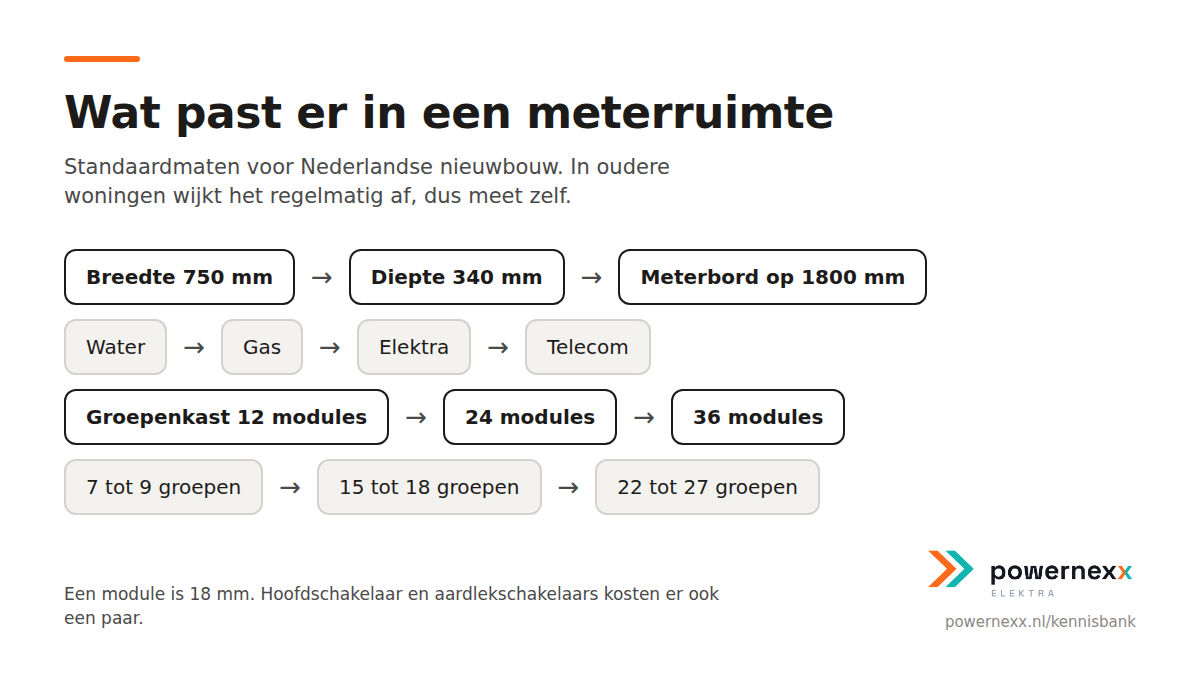
The standard Dutch meter space in new builds is about 750 mm wide and 340 mm deep, with the top of the meter board at about 1800 mm. In older homes it often differs. Before you order a bigger consumer unit: measure the free width on the meter board, not the cupboard itself.
The standard sizes
The layout of the meter space in Dutch homes is set by a standard (NEN 2768). The main dimensions for new builds:
| Dimension | Value |
|---|---|
| Width of the meter space | about 750 mm |
| Depth | about 340 mm |
| Height of the space | 2200 mm or more |
| Top of the meter board | about 1800 mm above the floor |
| Clear width of the door opening | at least about 600 mm |
Important: these are the sizes for new builds since the standard came into force. In homes from the sixties, seventies and eighties you come across every possible variation, from a cupboard in the hall to a small board in the cellar. So always measure yourself. And check the latest version of the standard if you are working on a new build, because the details are revised periodically.
What has to go in it
The meter space is not only for electrics. It usually also contains:
- the water meter with stopcock
- the gas meter and gas connection, if there still is one
- the connection for telecom and internet
- the electricity service connection with main fuses
- the electricity meter
- the consumer unit
- the earth connection
Each of these has its own zone on the meter board, and those zones are fixed. That is why you cannot simply use the whole width for a consumer unit.
How many modules fit
This is the question that really matters. Consumer units are measured in modules 18 mm wide.
| Enclosure width | Modules per row | Practical number of circuits |
|---|---|---|
| 12 modules | 12 | 7 to 9 |
| 24 modules (2 rows of 12) | 24 | 15 to 18 |
| 36 modules (3 rows of 12) | 36 | 22 to 27 |
| 48 modules (4 rows of 12) | 48 | 30 to 36 |
Why fewer circuits than modules? Because the main switch takes 2 or 4 modules and each RCD takes 2 modules. A 24-module consumer unit with three RCDs and a main switch has 14 modules left for circuits.
If you use RCBOs, each module is circuit breaker and RCD in one. That saves space in modules but costs more in material, and you have the advantage that never more than one circuit goes off at a time.
Do not know yet how many circuits you need? Go through the circuit planner, it works it out room by room for you, spare included.
Before you order a bigger consumer unit
Measure three things:
- The free width on the meter board, so what is really available next to the meter and the other connections. Not the width of the whole space.
- The free height above and below the existing consumer unit. An enclosure with four rows is considerably taller.
- The depth, including the door. Some enclosures with a door and a cover plate stick out further than you think.
And look at where the existing cables come in. If everything comes in from below and the new consumer unit has its entry at the top, it becomes a matter of trial and error.
If there really is no space
Three solutions, in order of preference:
- RCBOs instead of RCDs. More compact per circuit, and functionally better. More expensive in material.
- An add-on unit next to or below the main consumer unit, linked to it. Works well if there is still a bit of wall free somewhere. See extending the meter cupboard.
- A distribution board elsewhere in the house, for example a sub-board in the loft for the loft circuits or in the garage for the EV charger and workshop. Then only one heavier cable needs to run there.
Option 3 is often the tidy solution in larger homes, and nobody thinks of it.
Can the meter cupboard be moved
The consumer unit can, the meter not just like that. Moving the connection and the meter is the grid operator's work, has to be applied for and quickly costs more than a complete new consumer unit. Allow a lead time of weeks to months.
What can be done without the grid operator: moving the consumer unit to another spot in the same space, or moving it to an adjoining room as long as the supply from the meter stays within the permitted length.
From my own work
In a flat in Maastricht a 36-module consumer unit had been ordered online because a lot of circuits had to be added. During fitting the meter space turned out to be 620 mm wide instead of 750, because it was a converted building from 1930. The consumer unit literally did not fit between the walls. In the end two 24-module units one above the other, linked together. Worked fine, but measuring once beforehand would have saved the trouble.
When to call an electrician
If you are not sure whether what you want will fit. Send a photo of the meter cupboard with the door open via WhatsApp, plus a photo where you show the free width with a tape measure. Then I will know within a few minutes what is possible.
If it is a complete replacement, see consumer unit replacement or request a quote straight away.
Frequently asked questions
What is the standard width of a meter cupboard?
In Dutch new builds about 750 mm wide and 340 mm deep. Older homes often differ.
How many modules does a standard consumer unit have?
Usually 12, 24 or 36. A module is 18 mm wide. Bear in mind that the main switch and RCDs also take modules.
May I move the meter cupboard?
The consumer unit yes, the meter and the connection only via the grid operator. That is an application with a lead time of weeks.
May I store things in the meter cupboard?
Preferably not. The space must stay accessible and ventilated, and flammable material right next to a distribution board is not a good idea.
Does the meter cupboard need ventilation?
Yes, there should be air circulation. With a gas connection that is also a safety requirement.
Can I have it checked whether my consumer unit still meets the requirements?
You can. With an electrical inspection of your home I test everything and you get a report with the test results.
Further reading
Which consumer unit brand should you choose? Hager, Schneider, ABB and the rest
All brands are equally safe. The difference is whether you can still add a circuit in eight years' time, and that is exactly what nobody tells you.
Connecting an RCD: how it should be done and why it is not a DIY job
Where it sits in the chain, how it works and the neutral fault that explains nine out of ten RCDs that trip at random.
Wiring in the consumer unit: which wire, which colour, which cross-section
Wire type, colours and cross-section per breaker, plus the mistake that most often causes a hot terminal. Background, not DIY instructions.
Questions and comments
Ask your question below. Ask before 17:00 on a working day and you get an answer from Kevin himself the same day. No account needed, and your email address does not appear on the site.