
Short answer
All the major brands meet the same standards and are equally safe. The difference is in whether components will still be available in ten years, how pleasant the consumer unit is to extend, and whether your electrician works with it every day. I choose Hager as standard, but on request I build with any brand.
First this: safety is not a difference
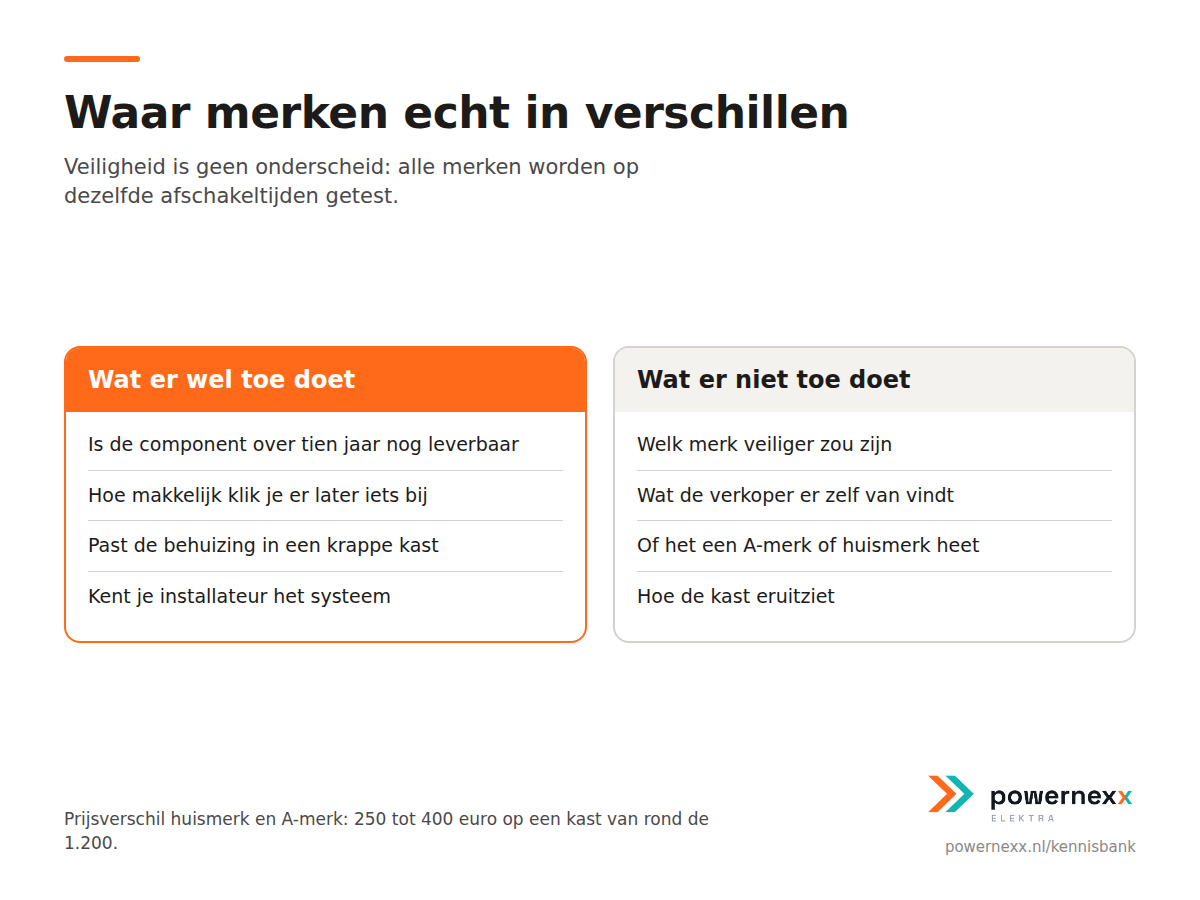
Every consumer unit and every component sold legally in the Netherlands meets the European standards and what NEN 1010 requires. An RCD from brand A does not switch off more safely than one from brand B. Both must trip within the same time at the same leakage current, and that is tested.
If a salesperson or electrician tells you that brand X is "safer", that is not true. Ask what exactly he means.
What does differ
1. Availability in ten years' time
This is the most important point and nobody mentions it. In eight years you want to add a circuit. Then you need a breaker that fits the busbar of your consumer unit and fits the opening in your cover plate.
Brands that have supplied the Netherlands for decades and whose ranges last a long time have the advantage here. Own brands and cheap import brands are regularly replaced by a slightly different range, and then it just does not fit any more.
2. Busbar and linking system
The busbar is the copper strip that links the line to all the breakers. How that system is set up determines how quickly and how neatly a consumer unit can be built, and above all how easily you can fit something in between later.
With some systems you have to pull out the whole row to extend. With others you simply clip in an extra module. You do not notice that difference at handover, but you do at the first extension.
3. Width per module and dimensions
All brands work with 18 mm modules, but the enclosures differ in height and depth. In a cramped meter space that can make just the difference. See meter cupboard dimensions.
4. Price
Realistically there is a 20 to 40 percent difference in material price between an own brand and a premium brand. On a complete consumer unit of € 2.231 excl. VAT you are then talking about a few hundred euros on the whole, because the material is only part of that price. Not nothing, but set against twenty years of use and the chance of an awkward extension it is a limited amount. The full price breakdown is on cost of consumer unit replacement.
The brands in brief
Hager. What I use as standard. Consistent system, components that stay available for a long time, easy to extend. A bit more expensive than average. Also strong at the heavier end (distribution boards, commercial).
Schneider Electric. Large and broad range, strong in building automation and commercial installations. A fine choice. If there is already a Schneider consumer unit and you only want to extend it, you simply stick with that.
ABB (Hafonorm). In the Netherlands for a very long time, many electricians know the system by heart. You come across it most often in existing homes. Extending an existing ABB consumer unit is usually no problem.
Eaton (Holec). Solid, found a lot in older Dutch installations and in industry.
Own brands and import brands. Meet the standards and work. The risk lies in availability in the long term and sometimes in the finish of the enclosure. Fine for a temporary situation or an outbuilding, but I would not do it for the main consumer unit of your home.
What to look for in a quote
Not the brand, but these things:
- RCBOs or RCDs? RCBOs cost more but make sure that never more than one circuit goes off with a fault. They are my standard unless the customer wants otherwise.
- How many empty modules are left? Fewer than four is too few. Check it with the circuit planner.
- What type of RCD is it? Type AC is no longer allowed in new installations. Type A is the basis, and with an EV charger there is more to it. See EV charger at home: single-phase or three-phase.
- Is surge protection included? In homes with solar panels or a lot of electronics it is worth considering.
- Are the testing and the handover report included in the price? If not, it is not a complete quote.
Do you have to stay with the same brand when extending?
For the breakers and RCDs: yes, because they have to fit the busbar and the cover plate. For a complete new consumer unit: no, then you choose freely.
What can be done: another consumer unit next to it in a different brand, with its own supply. Not the prettiest, but a solution if the existing brand is no longer available.
From my own work
At a house in Stein there was a consumer unit from a brand that had gone off the market four years earlier. One circuit had to be added for an air conditioner. There was not a single breaker to be had that fitted that busbar. In the end a small add-on unit next to it with its own supply, which turned out three times as expensive as adding one breaker. That is exactly why I look for brands that stay available for a long time.
When to call an electrician
If you have a quote and want to know whether it is right. Send it on, I will look at it free of charge. It takes me ten minutes and sometimes saves you hundreds of euros, or a consumer unit that is already too tight in three years.
If you want to know what customers think of my work, read the customer reviews. Ready to go: request a quote.
Frequently asked questions
Is one consumer unit brand safer than another?
No. All brands sold legally meet the same standards and are tested on the same tripping times.
Why do you work with Hager?
Because the system is consistent, components stay available for a long time and extending is easy. If you want another brand, I will simply build that.
Can I mix brands in one consumer unit?
Better not. Breakers from different brands often do not fit on the same busbar or in the same cover plate.
Is an own brand a bad choice?
Not unsafe, but a risk in the long term. The ranges are replaced more often, which can make extending difficult over the years.
What is the cost difference between an own brand and a premium brand?
For a complete domestic consumer unit, realistically € 250 to € 400 on a total of around € 1.200.
How do I know which brand I have now?
It is usually on the cover plate or on the breakers themselves. Otherwise send a photo via WhatsApp and I will tell you.
Further reading
Connecting an RCD: how it should be done and why it is not a DIY job
Where it sits in the chain, how it works and the neutral fault that explains nine out of ten RCDs that trip at random.
Meter cupboard dimensions: what fits and what are the requirements?
The standard sizes, how many modules really fit and the three things you need to measure before you order a bigger consumer unit.
Wiring in the consumer unit: which wire, which colour, which cross-section
Wire type, colours and cross-section per breaker, plus the mistake that most often causes a hot terminal. Background, not DIY instructions.
Questions and comments
Ask your question below. Ask before 17:00 on a working day and you get an answer from Kevin himself the same day. No account needed, and your email address does not appear on the site.