
Short answer
With an analogue clock you push out the tappets for the hours it should be on, and turn the dial to the correct time. With a digital clock you first set the current time and day, then the on and off times per programme. If your lighting comes on at the wrong time, the clock has almost always fallen behind after a power cut.
What they are used for
- Outdoor lighting and garden lighting
- Illuminated signs at commercial premises
- Pond pump or filter system
- Water heater only during off-peak hours or only when the sun is shining
- Ventilation in a commercial space
- Lighting in a communal area of an owners' association (VvE)
What people often do not know: a time switch can also save money with solar panels. A water heater that switches on around midday uses the electricity you would otherwise feed back. As net metering pays less and less, that becomes more interesting. See solar panels and your consumer unit.
Setting an analogue one
An analogue time switch has a rotating dial with small tappets or segments around the edge. Each segment is usually 15 or 30 minutes.
Step 1. Turn the dial clockwise until the current time is at the arrow or marker. Always turn it the way the clock itself turns, never backwards.
Step 2. Push the segments out (or in, depending on the model) for the periods the appliance should be on. If you want lights from 17:00 to 23:00, push all the segments between those times.
Step 3. Set the manual switch to the automatic position. Usually a small slider with the positions on, off and clock.
Step 4. Check it by turning the dial round once and seeing whether it clicks at the right moments.
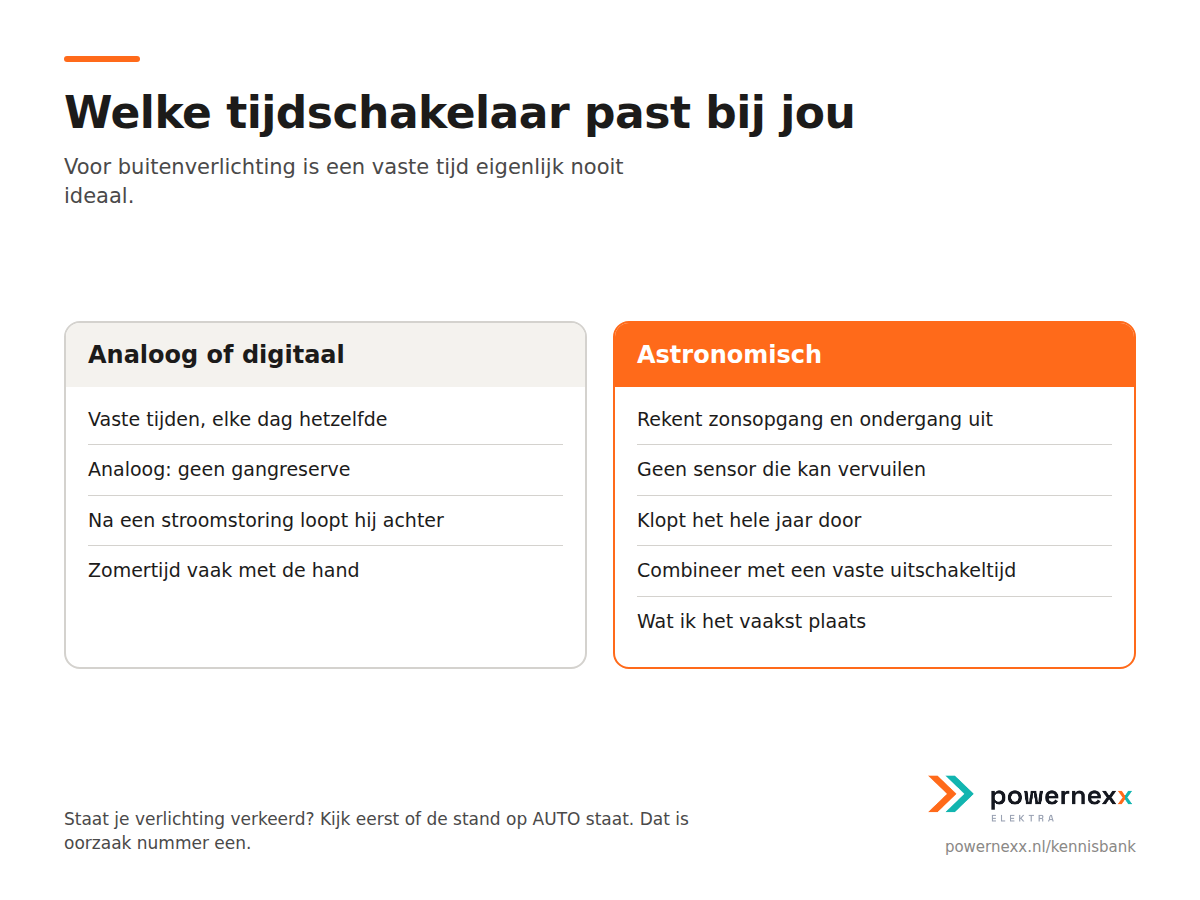
Drawback of analogue: no power reserve, or a few hours at most. After a power cut the clock is behind by exactly as long as the power cut lasted. That is why many people's outdoor lighting is consistently half an hour out.
Setting a digital one
Each brand has its own menu, but the pattern is the same on almost all of them.
Step 1. Reset. With a new clock, first reset it with a pointed object in the reset hole. That clears any factory programmes.
Step 2. Current time and day. Find the clock button, hold it down and set the year, date, day and time with the plus and minus buttons.
Step 3. Programming. Press the programme button. You get an on time (often ON or 1 ON). Set the time, choose the days (every day, weekdays only, weekend only). Press again for the off time.
Step 4. More programmes. Most clocks have 8 to 20 memory slots. That way you can switch from 06:30 to 08:00 in the morning and from 17:00 to 23:00 in the evening, for example.
Step 5. Back to automatic. Set the operating mode to AUTO. If it is on ON or OFF, it ignores the programme.
Step 6. Summer time. Check whether the clock changes over automatically. If not, put it in your diary twice a year.
Dusk-to-dawn switch and astronomical clock
For outdoor lighting a fixed time is never really ideal. In December it gets dark at four o'clock, in June at half past ten.
Dusk-to-dawn switch. A sensor outside measures the light and switches at an adjustable threshold. Advantage: always at the right moment. Drawback: the sensor can get dirty, and if a street lamp or your own light shines on it, it starts flicking on and off. Mount it facing north and away from your own lighting.
Astronomical time switch. Calculates sunrise and sunset based on the date and location. No sensor needed, so nothing that can get dirty. You set the coordinates or a location code and after that it is right all year.
Combination. Astronomical switching with a fixed switch-off time. The lighting comes on at sunset and goes off at 23:30. That is what I fit most often in homes, because it saves electricity and is never wrong.
The clock is wrong: what now
- Check whether the operating mode is on AUTO. Cause number one. Someone once switched it on manually and forgot to switch it back.
- Check the current time on the clock. After a power cut it is behind, unless it has a power reserve.
- Check summer time. Clocks without automatic changeover are an hour out for half of every year.
- With a dusk-to-dawn switch: check the sensor. Dirty, or light shining on it.
From my own work
At commercial premises in Sittard the facade lighting stayed on every night until the morning. The analogue clock had fallen four hours behind after a power cut and nobody had corrected it. Over a year that cost a few hundred euros in electricity. Replaced with an astronomical clock with a fixed switch-off time, paid for itself within a year.
When to call an electrician
For fitting a time switch in the consumer unit (that is work on 230 volts), for replacing an analogue clock with an astronomical one, and for setting up outdoor lighting at commercial premises and owners' associations (VvE).
If it is about a complete lighting installation or outdoor lighting, I will do it properly in one go. Request a quote.
Frequently asked questions
Why is my time switch always wrong?
Usually because there was no power reserve after a power cut, or because the clock does not change over to summer time automatically.
What is the difference between a dusk-to-dawn switch and an astronomical clock?
The dusk-to-dawn switch measures the actual light with a sensor. The astronomical clock calculates sunrise and sunset based on date and location, without a sensor.
Can I set a time switch myself?
Setting it, yes, that is done on the front. Fitting and connecting it in the consumer unit is work for an electrician.
How many modules does a time switch take?
Usually 1 to 2 modules on the DIN rail.
Can a time switch lower my energy bill?
Yes, especially with outdoor lighting that would otherwise stay on too long, and with a water heater that you let run during cheap or self-generated hours.
What does the AUTO setting mean?
That the clock follows the programme you have set. In the ON or OFF settings the programme is ignored.
Further reading
Which consumer unit brand should you choose? Hager, Schneider, ABB and the rest
All brands are equally safe. The difference is whether you can still add a circuit in eight years' time, and that is exactly what nobody tells you.
Connecting an RCD: how it should be done and why it is not a DIY job
Where it sits in the chain, how it works and the neutral fault that explains nine out of ten RCDs that trip at random.
Meter cupboard dimensions: what fits and what are the requirements?
The standard sizes, how many modules really fit and the three things you need to measure before you order a bigger consumer unit.
Questions and comments
Ask your question below. Ask before 17:00 on a working day and you get an answer from Kevin himself the same day. No account needed, and your email address does not appear on the site.