
Short answer
Solar panels need their own final circuit with its own protection. With one inverter that often simply fits in your existing consumer unit, provided there is room. With several strings, a home battery or a three-phase system, a separate PV distribution board is wiser. Expect € 250 to € 700 excl. VAT for the electrical part, separate from the panels themselves.
What changes when panels go on your roof
Until now electricity went one way: from the street, through the meter, into your house. With solar panels it goes both ways. The inverter converts direct current from the panels into alternating current and pushes it into your installation. What you do not use yourself goes back into the grid through the meter.
That has three consequences for your meter cupboard:
- A final circuit must be added for the inverter to connect to.
- That circuit must be tested and protected in both directions, so the cable cross-section is calculated on the power the inverter delivers, not on what is consumed.
- The load on your connection changes. With a 5 kW single-phase system you push 22 amps back on one phase, and you notice that in the grid voltage.
When it fits in your existing consumer unit
Often it simply does, provided:
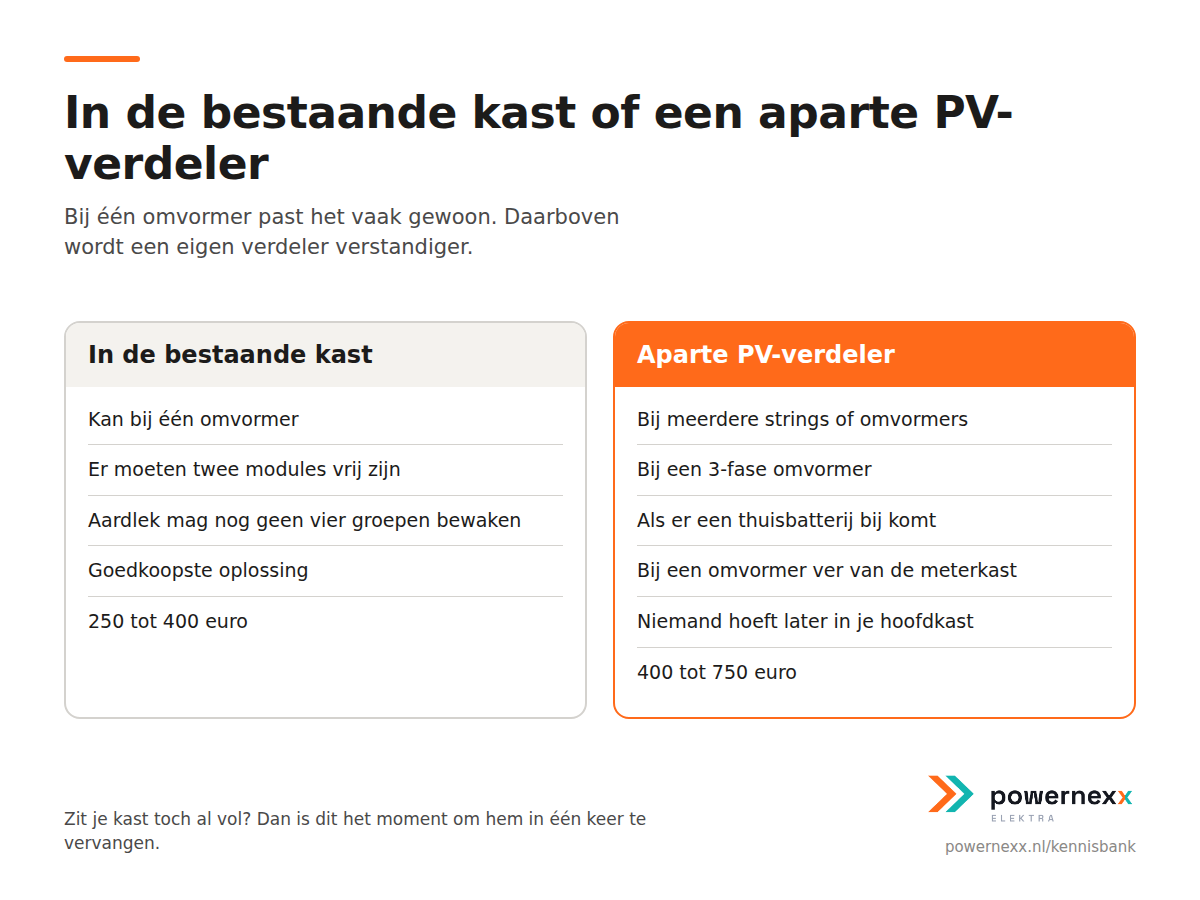
- there are at least two free modules (one breaker plus space)
- there is an RCD available that is not already protecting four final circuits
- the earth connection of the installation is in order
- the consumer unit is not from the seventies
If your consumer unit is full, this is THE moment to consider replacing it in one go. See consumer unit replacement or, if it is only about space, extending the consumer unit. The installer is there anyway, the meter cupboard is open anyway, and afterwards you have room for the home battery you will want in three years.
Want to know how many circuits you really should have, even without panels? Go through the circuit planner.
When you want a separate PV distribution board
A PV distribution board is a small unit next to or below the main consumer unit, specifically for the solar part. I recommend one in these cases:
- Several inverters or several strings. Each with its own protection, clearly grouped together.
- Three-phase inverter. Then you need 4-pole protection and that eats up space in the main unit.
- A home battery as well, now or later. Battery plus inverter plus EV charger in the main unit becomes a puzzle.
- The inverter is far from the meter cupboard, for example in the loft. Then you put the protection close to the inverter.
- Commercial or larger installations. Almost always.
An advantage people underestimate: if work is done on the PV system later, nobody needs to be in your main consumer unit. That saves hassle and risk.
Grid voltage too high: why your inverter cuts out
This is the question I get asked most about solar panels, and people rarely get an honest answer to it.
The grid voltage in the Netherlands is nominally 230 volts, with a permitted range up to 253 volts. As soon as your inverter pushes power back into the grid, it has to do so at a voltage just slightly higher than what is on the grid. Otherwise nothing flows.
If your street is already at 245 volts because the neighbours all have panels too, your inverter has to go towards 253 volts. At that point it switches itself off, because it is not allowed above that. Result: on the sunniest afternoon of the year your installation delivers nothing.
What you can do about it:
- Increase the cable cross-section between inverter and meter cupboard. A thin or long cable causes voltage drop, and that adds to the grid voltage. This is where I can actually solve something, and where corners are most often cut on quick installations.
- Spread over three phases if you have three-phase. Then you push back a third per phase and the voltage rise stays limited.
- Use more yourself when the sun is shining. Heat pump water heater, EV charger on surplus, home battery.
- Report it to the grid operator. They are obliged to keep the voltage within the standard. If they measure consistently high values, they have to act. It takes a long time, but it does work. Keep your inverter's log data as evidence.
What does NOT work: raising the limit in your inverter. That is not allowed and it solves nothing, it only moves the problem to your neighbours.
If you live in an area where the grid is full, this plays a bigger part. With the grid congestion check you can see by postcode how the grid is doing where you live.
What it costs
Excl. VAT, prices as of August 2026.
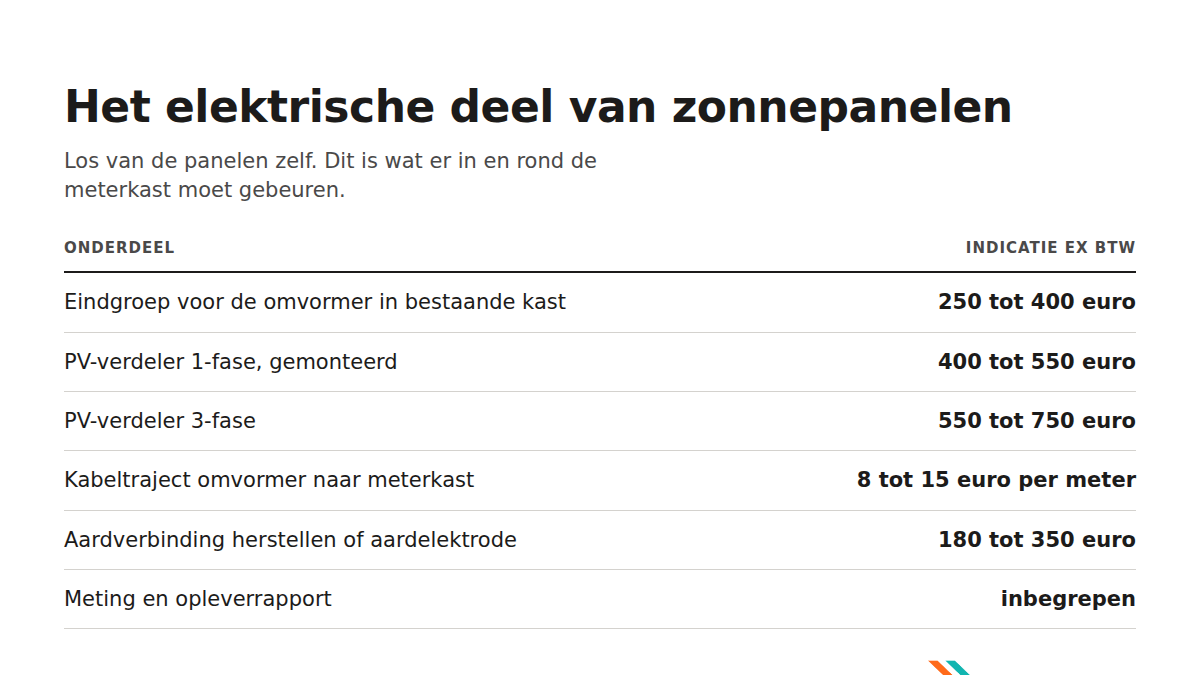
| Item | Indication |
|---|---|
| Final circuit for the inverter in an existing consumer unit | € 250 to € 400 |
| PV distribution board single-phase, fitted and connected | € 400 to € 550 |
| PV distribution board three-phase | € 550 to € 750 |
| Extra: cable run from inverter to meter cupboard | € 8 to € 15 per metre |
| Repairing the earth connection or fitting an earth electrode | € 180 to € 350 |
| Testing and completion report | included |
Check what is in your solar panel supplier's quote. With many providers "connection to the meter cupboard" is a zero-euro line that only applies if everything fits exactly. If your consumer unit is full or the earth is missing, extra work follows. Ask about that beforehand. How my hourly rate is built up is explained on what does an electrician cost.
The net metering scheme is ending: what does that mean for your installation
From 2027 the net metering scheme changes. Without going into the politics: the effect is that feeding back earns less and using it yourself becomes worth more.
For your installation that means three things:
- A home battery becomes more attractive. Make sure there is room in the consumer unit and that the connection allows it.
- Charging on surplus becomes more attractive. If you have or are considering an EV charger, choose a model that can charge on surplus. See EV charger at home: single-phase or three-phase.
- Controlling consumption becomes more attractive. Water heater, heat pump or dishwasher that switch on when the sun is shining.
What I advise people: include this in the design of your consumer unit, even if you are not buying a battery yet. Four extra empty modules cost nothing now and save you a whole unit swap later.
What you should get from your installer
- A diagram of how the PV part is connected
- Test values: insulation resistance of the PV circuit, earth electrode resistance, and the measured grid voltage at full load
- The inverter settings, including the configured country and grid profile
- Photos of the connection
Ask specifically for that measured grid voltage at full load. If it is already above 248 volts at handover, you know now that you will have problems in summer and you can do something about it straight away.
Did you not get that information and still want to know how your installation is doing? That is part of an electrical inspection of your home.
From my own work
At a home in Elsloo the inverter cut out every afternoon between twelve and three. The panel installer pointed at the grid operator, the grid operator pointed back. Testing showed the cable from the loft to the meter cupboard was 2.5 mm² over eighteen metres, when it should have been 4 mm². Just replacing that cable gained almost 4 volts, just enough to stay below the limit. Half a day's work, and the problem was gone.
When to call an electrician
I do not install panels myself, but I do the electrical part: the connection, the PV distribution board, solving cut-outs caused by high grid voltage and the preparation for a home battery. Exactly what I do is on connecting solar panels.
If your panels are not delivering what they should, an afternoon of testing is usually enough to know whether it is the installation or the grid.
Request a quote, or for an urgent problem go to the 24/7 fault service and choose a time slot yourself.
Frequently asked questions
Do solar panels need their own circuit?
Yes. The inverter gets its own final circuit with its own protection, matched to the power it delivers.
Why does my inverter cut out in sunny weather?
Almost always because the grid voltage is too high. That comes from voltage rise on the grid, often made worse by voltage drop in a cable that is too thin between inverter and meter cupboard.
Can I connect solar panels to a single-phase connection?
Yes, up to about 5 kW of inverter power. Above that, the feed-in on one phase becomes too large and three-phase is wiser. See three-phase connection costs.
Do I need a PV distribution board?
Not always. With one inverter and enough room in the consumer unit it can simply go in there. With several strings, three-phase or a planned home battery, a PV distribution board is better.
Can I connect the inverter myself?
No. Connecting to the final circuit is work for an installer, and with most manufacturers the warranty is void without an installation certificate.
What happens to my installation when the net metering scheme ends?
Technically nothing. But using it yourself becomes more important, which makes a home battery or charging on surplus more attractive. Take that into account in the design of your consumer unit.
My RCD has been tripping since the panels were installed. How can that be?
Inverters have a small leakage current of their own. If your RCD was already close to its limit because of other appliances, the inverter tips it over. Go through the step-by-step plan for a tripping RCD; the solution is usually to spread the circuits over a second RCD.
Further reading
A dynamic contract and a home battery: is it worth it
With a dynamic contract the battery can charge when electricity is cheap. That works, provided you let it be controlled automatically.
The net metering scheme is ending: what changes for my panels
Your panels keep generating just as much. What changes is the value of the electricity you feed back.
Feed-in charges: why you pay for your own electricity
More and more suppliers charge for feeding your solar power back into the grid. Your bill shows what that costs you.
Questions and comments
Ask your question below. Ask before 17:00 on a working day and you get an answer from Kevin himself the same day. No account needed, and your email address does not appear on the site.