
Short answer
One room without power almost always means one circuit has tripped. Look in the meter cupboard to see which narrow switch is down, push it back up and see whether it stays on. If it stays on, it was a spike. If it goes off again straight away, there is a short or an overload behind it.
First this: is it one room or one circuit
Those two are not the same, and that difference is half the search.
A circuit rarely matches a room exactly. In many homes the lighting of the whole ground floor is on one circuit and the sockets on another. So it may be that in your living room the lights work but the sockets do not, or the other way round.
So first walk round the house and note what works and what does not. Is a socket in the bedroom upstairs also not working? Then it is on the same circuit and you immediately know more.
If your circuit chart is no longer right, this is exactly the moment you notice how much time that costs.
The step-by-step plan
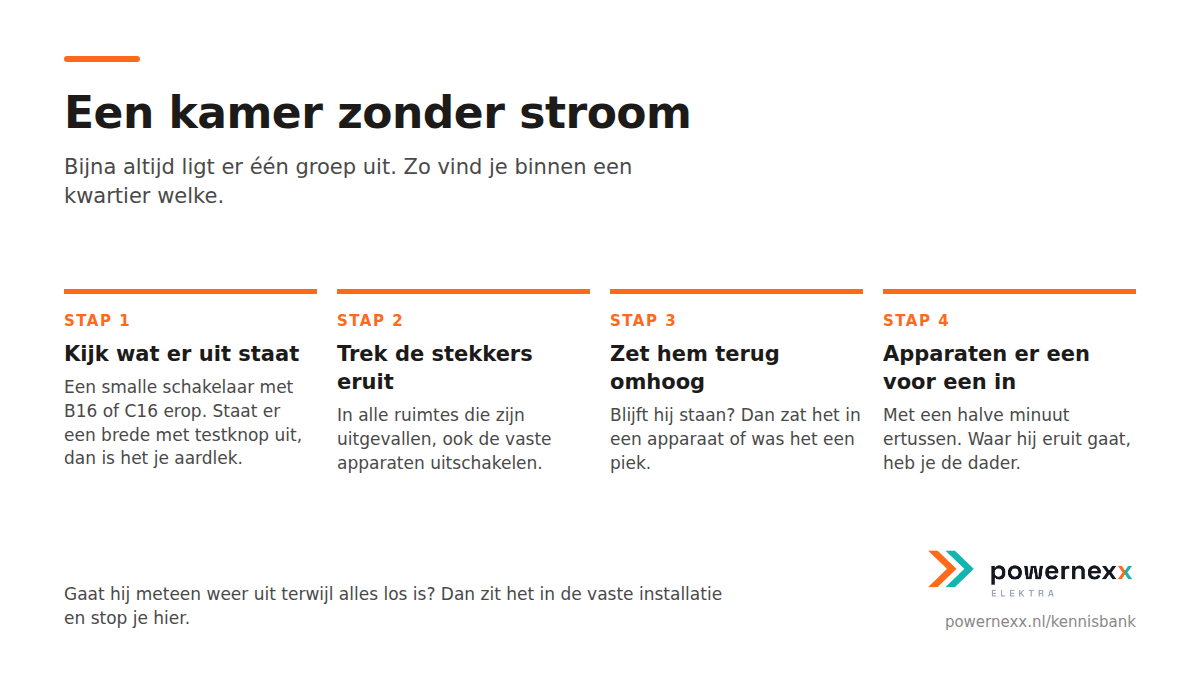
Step 1. See which switch is off. Open the meter cupboard. Look for the narrow switches marked something like B16 or C16. One of them is down. That is the one.
If a wide switch with a test button is down, something else is going on: then it is your RCD and several circuits have gone off at once. In that case go to RCD keeps tripping.
Step 2. Pull out the plugs first. Unplug everything in the rooms that have lost power. Also switch off hard-wired appliances with their own switch.
Step 3. Push the switch back up. Does it stay on? Then it was in an appliance or it was a spike when something switched on.
Step 4. Plug the appliances in one by one. With half a minute in between, and actually switch them on. The moment the switch trips again, you have found the culprit.
What if it trips again straight away
If the breaker trips again immediately while everything is disconnected, the problem is in the fixed installation. Usually one of these three:
- A short circuit in the wiring. For example a screw or a nail that once went through a cable when a shelf was put up or a floor was laid.
- A faulty socket or switch. Damp, a loose wire, or a connection that has worked loose over the years.
- A junction box. Often hidden behind a ceiling or in a wall, and that is exactly why you stop here and call.
What you must not do here: fit a heavier breaker. The breaker protects the cable, and a heavier breaker means the cable can get hot before anything switches off. See wiring in the consumer unit.
What if nothing in the consumer unit has tripped
This happens more often than you think, and then the search is in the house instead of in the consumer unit.
Possibilities:
- A connection in a junction box or socket has come loose. Looped wiring where one loose wire cuts off everything beyond that point. A classic after a light has been moved.
- The switch is broken inside while it looks normal from the outside.
- An RCBO stuck halfway. Some models do not drop all the way. Push it fully down first and only then back up.
- Only that one socket is broken, and the rest of the circuit works fine. Test with a lamp you know works.
From my own work
At a home in Beek half the upstairs was not working, and in the meter cupboard everything was neatly up. It turned out to be a junction box above the landing ceiling, where a core had slipped out of a terminal block when a new ceiling light was fitted. Everything beyond that junction box was off. Twenty minutes searching with a voltage tester, five minutes repairing.
When to call an electrician
- The breaker trips again straight away while everything is disconnected.
- Nothing in the consumer unit has tripped, but there is still no power.
- You smell burning or see discolouration at a socket or in the consumer unit.
- You have found the culprit and it is a hard-wired appliance or fixed wiring.
I do fault finding with an insulation test and, where needed, a thermal imaging camera. Usually it is clear within an hour. Count on € 85 per hour plus € 59,99 call-out charge, both excluding VAT, the same nationwide. Prices as of August 2026. The breakdown is on what an electrician costs.
Through the fault service you enter your postcode and pick a time slot yourself. You do not have to wait for someone to call back.
Frequently asked questions
Can I push the breaker back up myself?
Yes. You may operate anything you can operate by hand. Unscrewing the cover of the consumer unit is not allowed.
Why does it trip again straight away?
Then there is a short circuit or an ongoing overload. If everything is disconnected and it still trips straight away, it is in the fixed installation.
Could it be the outdoor lighting?
Certainly, especially after rain or frost. If outdoors is on its own circuit, you know straight away. See outdoor lighting.
What does a fault investigation cost?
Hourly rate plus call-out charge. In a home you usually pay between € 145 and € 230 excl. VAT including a small repair.
Why is more off than just that one room?
Because a circuit rarely matches a room. Often the lighting of a whole floor is on one circuit and the sockets on another.
Can I fit a heavier breaker if it trips often?
No. The breaker protects the cable. Tripping more often means there is too much on that circuit, and then a circuit needs adding.
Further reading
RCD keeps tripping: how to find the cause yourself
Usually it is one appliance and not your installation. In four steps you find out yourself which one, and you read exactly where it stops and you need to call.
Lights flickering or dimming: what it tells you
Flickering in one light is usually the bulb or the dimmer. Flickering throughout the house is a reason to measure.
The circuit breaker trips: overload or short circuit
A breaker that only trips after a while points to overload. If it trips straight away, it is a short circuit.
Questions and comments
Ask your question below. Ask before 17:00 on a working day and you get an answer from Kevin himself the same day. No account needed, and your email address does not appear on the site.