
Short answer
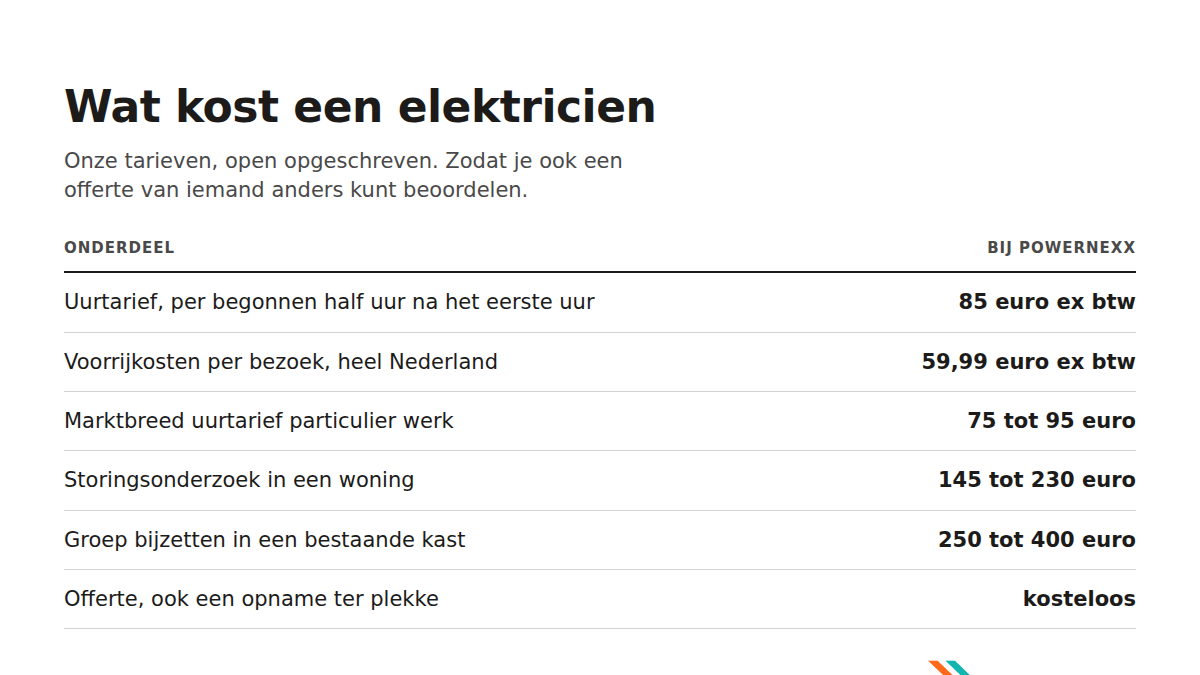
Expect € 75 to € 95 per hour excl. VAT, plus a call-out charge. With me that is € 85 per hour and a € 59,99 call-out charge, both excluding VAT, nationwide and regardless of distance. Materials come on top, with a margin you are welcome to ask about. Prices as of August 2026.
Why hardly anyone is open about this
Ask ten installers for their rate and you get "it depends" ten times. That is partly true and partly a way of avoiding the conversation.
I simply write it down here, for two reasons. You can then judge for yourself whether a quote is reasonable, even if you get it from someone else. And I do not have to be long-winded on the phone about something that ends up on the invoice anyway.
The hourly rate and what it covers
Across the market, an electrician for domestic work charges between € 75 and € 95 per hour excl. VAT. With me it is € 85 per hour excl. VAT.
These are the three amounts that almost every invoice is built from. As a private customer you pay the amount on the right, as a business the amount on the left.
| Excl. VAT | Incl. VAT | |
|---|---|---|
| Labour | € 85 per hour | € 103 per hour |
| Call-out charge per visit | € 59,99 | € 72,59 |
| Fault finding, fixed fee | € 95 | € 115 |
What that hour covers:
- The work itself
- Tools and test equipment, including their annual calibration
- Insurance, training and keeping up my NEN 3140 competence
- Admin, quotes and the time to answer your question
- The van, fuel and stock
What it does not cover: materials, call-out charge and VAT.
How I count: per half hour started, after the first hour. So a ten-minute job is not an hour. A 65-minute job is an hour and a half, not two.
Call-out charge: why a fixed amount is fairer
I charge a € 59,99 call-out charge excl. VAT, nationwide, regardless of distance. Whether you live in Maastricht or in Groningen.
That is a deliberate choice. The usual approach is a rate per kilometre or per zone, and then you do not know in advance what you will pay and there is always discussion about the route. With one amount you know straight away.
It also means that nearby is slightly more expensive than strictly necessary and far away slightly cheaper. I think that is acceptable: measured over a year it evens out, and it saves everyone hassle.
The call-out charge is charged once per visit, not per job. If I do three things at your home on the same day, you pay it once.
Materials and margin, openly explained
There is a margin on materials. That is nothing to be secretive about, it is how the trade works.
What that margin is for: purchasing, stock in the van, the risk that a component turns out to be faulty, and guarantee. If an RCD fails after a year, I come and replace it without invoicing. That is in the margin.
What you can expect:
- Your invoice states which materials were used, not just "materials: € 340"
- You may ask what the purchase price was
- If you supply materials yourself, that is possible, but the guarantee on that part is then your responsibility
VAT: 21 or 9 per cent
This causes the most confusion.
9 per cent applies to the labour part of renovating and repairing homes that are more than two years old. Materials are always 21 per cent.
21 per cent applies to new builds, homes less than two years old, commercial premises and anything that is not renovation or repair.
Two things that surprise people: the low rate applies only to labour, not to materials. And the rules have been changed several times in recent years, so this is something to have confirmed explicitly in the quote rather than assume.
For business customers who can reclaim VAT, the rate makes no difference in the end.
Fixed price or charged on actual time
A fixed price works for jobs that can be estimated well in advance: replacing a consumer unit, installing an EV charger, adding a number of sockets. You know where you stand beforehand. Even then the amount in my quote is a guide price: if more turns out to be needed on site, for example more hours, a longer cable or a change to the consumer unit, I discuss it with you first. I only do extra work with your approval.
Charging on actual time is fairer for investigative work: fault finding, an installation nobody knows, or work in a building that several parties have worked on. With a fixed price I would have to add a risk surcharge, and you pay that even if it turns out better than expected.
What I do when charging on actual time: if things go differently than expected, I call you before I carry on. Not afterwards on the invoice.
What a good quote contains
What to look for, also in a quote from someone else:
- Materials and labour separately. One amount without a breakdown tells you nothing.
- The number of hours or a fixed price, not "by arrangement".
- What is NOT included. A good quote names the risks: missing earth, asbestos, a meter cupboard that is too small.
- The VAT rate and why.
- Whether testing and a completion report are included. Without a test report you cannot prove, if there is damage, that everything was right at handover.
- Validity period and payment terms.
A quote that pins everything down in advance without having seen the installation is usually a quote that leads to extra work later.
What does an average job cost
Excl. VAT, prices as of August 2026, including materials and labour but without the call-out charge.
| Job | Indication excl. VAT |
|---|---|
| Fault finding in a home | € 145 to € 230 |
| Adding a socket (surface-mounted, short distance) | € 90 to € 160 |
| Adding a circuit to an existing consumer unit | € 250 to € 400 |
| Consumer unit replacement, three-phase standard package | € 2.231 |
| EV charger including installation | € 1.500 to € 2.500 |
| Home electrical inspection with report | from about € 185 |
| Fault finding, fixed fee | € 95 |
A complete example, from amount to contents
A price range says little as long as you do not know what is in it. This is the package that comes out of my quotes most often, a family home with three-phase:
- 12 circuits, fitted as RCBOs
- 3 type A RCDs
- 1 main switch, three-phase
- 1 PV circuit for the solar panels
- 1 power circuit, for example for the hob
- 1 doorbell transformer
- Test report and completed circuit chart
Including fitting and materials that comes to € 2.231 excluding VAT, or € 2.700 including VAT.
Does your home not fit that? The variants and what each choice does to the price are set out on consumer unit replacement costs.
Where to find the other prices
Each job has a page with the breakdown, so you do not have to rely on an average:
- Consumer unit replacement costs, depending on single or three-phase and the number of circuits
- Extending the consumer unit, if the unit stays but circuits need adding
- EV charger installation, including the change in the consumer unit
- Three-phase connection, including what the grid operator charges
- 24/7 fault service, with the rates and the time slots available
The hourly rates and payment arrangements are also in the terms and conditions.
When you pay nothing
- A quote costs nothing, even if you do not accept it.
- Advice via WhatsApp or phone costs nothing. Send a photo of your meter cupboard and you will simply get an answer.
- If I come round for a site survey for a bigger job, that is part of the quote and therefore free.
If I come round to repair something, hours and the call-out charge do count. The difference is: for a quote I come to look, for a fault I come to work.
From my own work
At a home in Sittard there was a quote of € 1.450 for a consumer unit, with only the line "replace consumer unit incl. materials". No number of circuits, no RCD type, no testing mentioned. On asking, it turned out to be a 12-module unit with two RCDs and no completion report. My quote was € 190 higher and included 24 modules, RCBOs and the test report. That is not an expensive offer, it is a different offer.
When to call an electrician
If you want to know roughly what something will cost before you have someone come round. That conversation costs you nothing.
If you already have a quote and are unsure whether it is right, send it to me. I will look at it free of charge.
Or read the customer reviews first. Ready to go ahead: request a quote. If it is a fault, go to the 24/7 fault service and choose a time slot yourself.
Frequently asked questions
Is the call-out charge included in the hourly rate?
No. With me it is a separate amount of € 59,99 excl. VAT per visit, fixed nationwide.
When does 9 per cent VAT apply?
For the labour part of renovating and repairing homes more than two years old. Materials stay at 21 per cent. Have it confirmed in the quote.
What if it takes longer than estimated?
When charging on actual time I call before I carry on, not afterwards. The same goes for a quote: the amount is a guide price, and if more turns out to be needed, I discuss it with you first.
Do I pay for a quote?
No, not even if you do not accept it. A site survey for a bigger job is also free.
Why do you charge the same call-out charge throughout the Netherlands?
Because then you know in advance what you will pay and there is no discussion about the route. That makes nearby slightly more expensive and far away slightly cheaper.
Can I supply materials myself?
You can. The guarantee on that part is then your responsibility, and for components in a consumer unit I advise against it.
Further reading
Electrics in the bathroom: what is allowed where
The bathroom is divided into zones. For each zone the standard sets what may be installed and how well it must be protected.
Electrics in a new kitchen: which circuits and where
A modern kitchen easily has four to six circuits. Induction almost always needs its own power circuit.
Concealed or surface-mounted cabling: what works where
Concealed is neater, surface-mounted is quicker and cheaper. In a load-bearing wall or a listed building you do not always have a free choice.
Questions and comments
Ask your question below. Ask before 17:00 on a working day and you get an answer from Kevin himself the same day. No account needed, and your email address does not appear on the site.