
Short answer
Press the test button (T) while the installation is simply on. The switch should drop out immediately. Then push it back up. If nothing happens, your RCD is not working and you currently have no protection against leakage current. Do this twice a year.
Why testing is needed
An RCD is a mechanical device. It contains a relay that does nothing for years and then has to work within thirty milliseconds. That mechanism can seize up through dust, corrosion or simply from never having moved.
The annoying part: a seized RCD looks exactly the same as a working one. Your installation works as normal. You only notice it does not work at the moment you need it, and that is exactly the wrong moment.
Manufacturers generally advise testing every six months. Put it in your diary for when the clocks change, then you will not forget. If you would rather not keep track yourself, that six-monthly check is included in my service plan.
How to do it
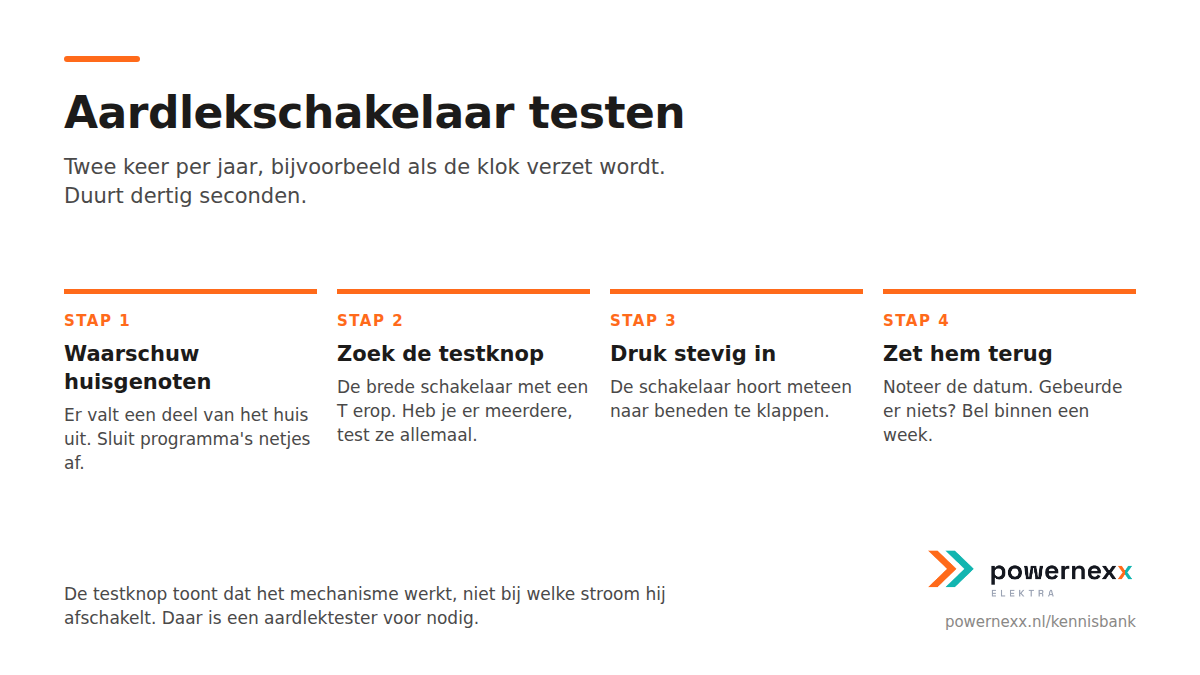
Step 1. Make sure you know what will go off. Shut down computers properly and warn the people you live with. You will probably need to reset the clock on the oven and the microwave afterwards.
Step 2. Open the meter cupboard. Look for the wide switch with a button marked T. If you have several RCDs, test each one separately.
Step 3. Press the test button firmly. The switch should snap down straight away, with a clear click. The circuits behind it go off.
Step 4. Push the switch back up. Everything works again.
Step 5. Note the date. On the circuit chart or in pencil on the inside of the meter cupboard door.
This is something anyone may do. You only operate what is on the outside. Unscrewing the cover is a different story and you do not do that.
What if nothing happens
If the switch stays on when you press the test button, something is wrong. Two possibilities:
- The mechanism has seized. Happens with switches that have not been tested for years.
- The switch is faulty. Electronically or mechanically broken.
In both cases: you currently have no protection against leakage current. That is no reason to panic, because the installation works as normal, but it is a reason to have someone come out within a week. Replacing an RCD is a half-hour job.
What you must not do: tap it hard until it happens to trip. Then you only know that it still moves mechanically, not that it trips at 30 milliamps.
What the test button does and does not prove
This is the point where almost every explanation on the internet stops, and it is exactly what an installer does know.
What the test button does prove: that the mechanism works and that the switch can switch off.
What it does not prove:
- Whether it trips at the right leakage current. The test button internally forces a leakage current that is usually well above the limit. A switch that only trips at 45 milliamps instead of 30 still trips with the test button, while in fact it no longer meets the requirement.
- Whether it trips fast enough. The standard requires tripping within set times. A slow switch still trips with the test button, but too late.
- Whether the earth connection of your installation is right. An RCD can work perfectly while there is no sound earth.
For those three things you need an RCD tester, and that is measuring work for an installer. It is a standard part of an electrical inspection and of handing over a new consumer unit.
How often, really
| Situation | Frequency |
|---|---|
| Home, testing yourself with the test button | twice a year |
| Home, measuring with an RCD tester | at handover and after that in case of doubt or age |
| Business premises | according to the NEN 3140 inspection frequency, see inspection and maintenance |
| After a lightning strike or a major fault | immediately |
| RCD older than 15 years | have it tested |
From my own work
At a home in Meerssen the RCD tripped neatly with the test button. The resident tested it properly every six months. A check with the RCD tester showed it only tripped at 42 milliamps and with a trip time well above the standard. Sixteen years old. Replacing it took forty minutes. With the test button alone that would never have come to light.
When to call an electrician
- The test button does nothing.
- The switch trips but will not go back up.
- Your RCD is older than fifteen years and has never been tested.
- You have no RCD. Then it is not a question of testing but of replacement, see consumer unit replacement.
I test RCDs with an RCD tester and record the values in a report. For a home that is usually done within the hour.
If it is urgent, go to the fault service and pick a time slot yourself. Otherwise you can request a quote.
Frequently asked questions
How often should I test my RCD?
Twice a year with the test button is a good routine. Link it to the clocks changing.
Can I press the test button myself?
Yes. You only operate what is on the outside. Anyone may do that.
What if the RCD does not trip with the test button?
Then it does not work and you have no protection against leakage current. Have it replaced within a week.
Does a successful test mean my RCD is in order?
Not entirely. The test button shows that the mechanism works, but not whether it trips at the right current and within the right time. That needs an RCD tester.
Will testing damage my computer?
No, but it will switch off abruptly. Close programs properly before you test.
How long does an RCD last?
There is no fixed lifespan, but over fifteen years testing it is sensible.
Further reading
Is my meter cupboard still safe? 10 things you can see yourself
Ten things you can see yourself without unscrewing anything. If you recognise three or more, it is time for a chat.
How old is my installation really: these are the signs
Cloth-covered wiring, no RCD, screw-in fuses and unearthed two-pin sockets: each feature tells you something about the year it was built and the risk.
Type A, type B or type F RCD: which do you need
Type A is the standard. Type B only where DC leakage can occur, and that is less often than sellers say. Saves hundreds of euros.
Questions and comments
Ask your question below. Ask before 17:00 on a working day and you get an answer from Kevin himself the same day. No account needed, and your email address does not appear on the site.