
Short answer
Most meter cupboards from before 1990 no longer meet what is asked of an installation today. You can check ten things yourself without unscrewing anything. If you recognise three or more, have it looked at. If you recognise one of the first four, that alone is reason enough.
What to look at, without tools
Open the meter cupboard door and take a calm look. Everything below can be seen from the outside. You do not need to undo anything, unscrew anything or touch anything except the switches that are there to be operated.
You do not take the cover off. Behind it is the supply from the main fuse, and that is live even when all breakers are off.
The ten signs
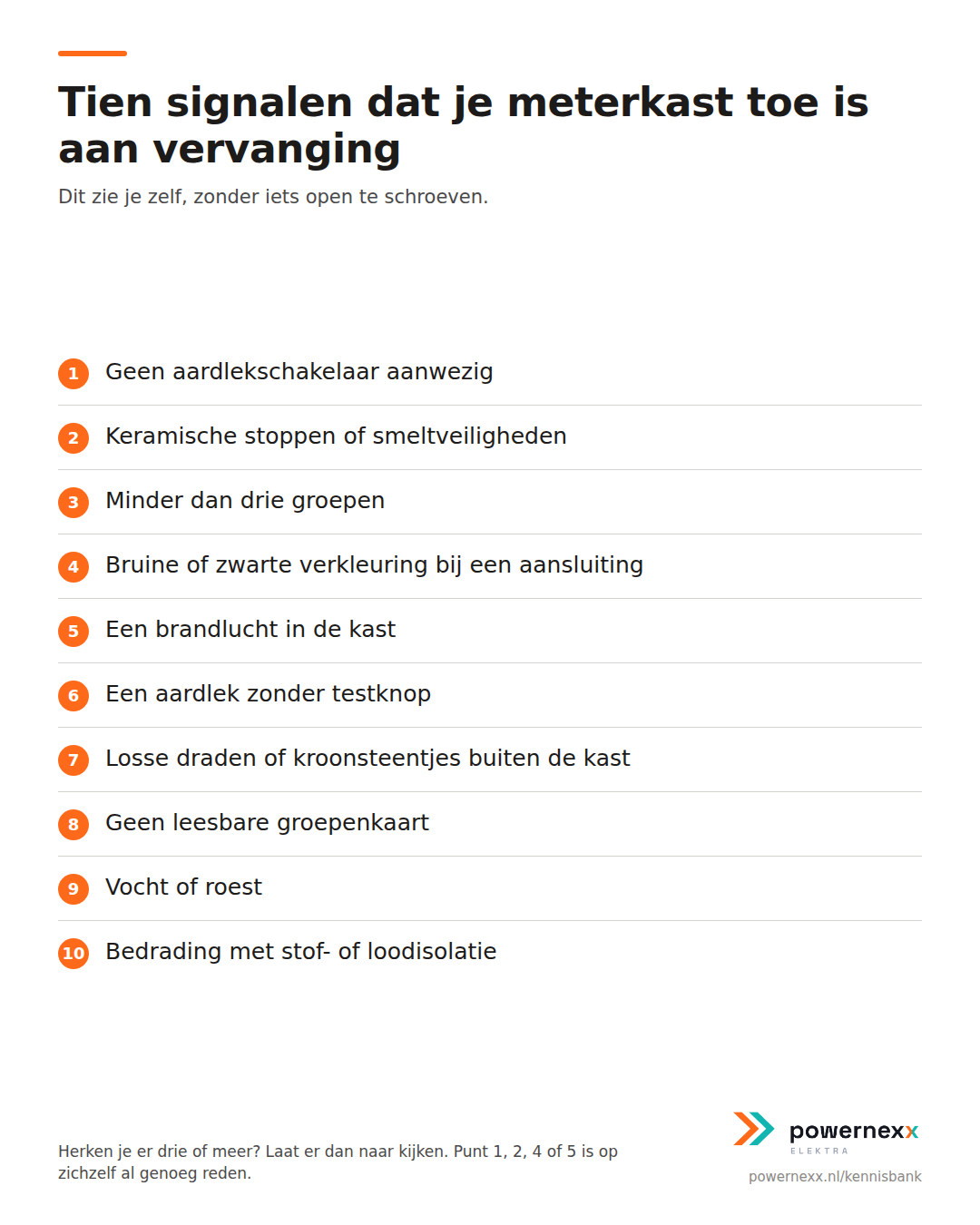
1. There is no RCD. Look for a wide switch with a test button, usually marked T. If there is none, you have no protection against leakage current through a person. This is the only point where I say: have this done this year. Consumer units from before 1975 often have no RCD.
2. Ceramic fuses or fuse cartridges. Round porcelain holders you screw a cartridge into. They do not switch off fast enough for modern equipment, and in practice people put in cartridges that are too heavy because the fuse keeps blowing.
3. Fewer than three circuits. Then the consumer unit was designed for a household of fifty years ago. See how many circuits you need.
4. Brown or black discolouration around a connection. That is heat that does not belong there. A connection that runs hot gets worse over the years. This is not something to leave until next month.
5. A smell of burning in the meter cupboard. A sharp or Bakelite-like smell. Call the same day.
6. An RCD without a test button. Without a test button you cannot check whether it still works, and that is exactly what fails. See testing your RCD.
7. Loose wires outside the consumer unit. Wiring running out past the unit, terminal blocks out in the open, a junction box held shut with tape. That is almost always DIY work added later.
8. No readable circuit chart. Not dangerous in itself, but a sign that the job was never properly handed over. And when there is a fault it costs time searching.
9. Damp or rust. With a meter cupboard against an outside wall or in a cellar. Damp and electrics do not mix, and rust on an earth bar means a bad connection.
10. Wiring with cloth or lead insulation. Still found in houses from before 1960. Fabric or lead around the cores instead of plastic. That insulation crumbles and then cores touch each other.
What it means if you recognise three or more
Then your installation is not acutely dangerous, but it is outdated. What that means in practice:
- You have less margin if something goes wrong.
- You cannot connect an EV charger, heat pump or induction hob without dealing with the consumer unit first.
- In the event of damage, an insurer may ask questions about the state of the installation.
Do you recognise point 1, 2, 4 or 5? Then that alone is reason enough to have someone come out, even if the rest looks fine.
Does it need doing straight away
Honest answer: it depends.
Yes, this year: no RCD, ceramic fuses, discolouration or a smell of burning, cloth or lead insulation.
Yes, as soon as you are doing something anyway: too few circuits, more than four circuits behind one RCD, the unit is full, you are going to renovate.
No: a consumer unit from the nineties with a working RCD, eight or more circuits and space left. It is technically fine, even if it looks dated. Do not let anyone talk you into anything.
More on that three-way split in consumer unit replacement.
What it costs
Excl. VAT, prices as of August 2026:
| Situation | Indication |
|---|---|
| Just adding an RCD, if there is space | € 250 to € 450 |
| Complete three-phase consumer unit, 12 circuits, the standard package | € 2.231 |
| Complete single-phase consumer unit | on quotation |
| Fitting an earth electrode if there is no earth | € 180 to € 350 |
| Electrical inspection with test report | from about € 185 |
Full breakdown on consumer unit replacement costs, and how my hourly rate is made up on what an electrician costs.
Knowing for sure instead of looking
Everything above is what you see with the naked eye. What you do not see: whether the earth connection is sound, whether the insulation resistance is still good, and whether your RCD really trips at 30 milliamps.
That needs measuring. During an electrical inspection of your home I test all circuits, test the RCDs for trip time and trip current, and you get a report with the values. That is also what an insurer or a buyer wants to see.
From my own work
At a home in Geleen the resident only wanted a quote for an EV charger. On opening the meter cupboard there turned out to be no RCD, in a house from 1968 where three children lived. The EV charger did go in, but only after the consumer unit. I would rather have that conversation at the kitchen table than afterwards.
When to call an electrician
With point 1, 2, 4 or 5. And if you simply want to know where you stand without anything having to be done straight away.
Quickest route: send a photo of your meter cupboard with the door open and a photo of the meter itself via WhatsApp. Then I can see what type of connection you have, how many circuits there are and whether there is an RCD. Usually I can then already tell you whether it is urgent.
If something is wrong right now, go to the fault service and pick a time slot yourself.
Frequently asked questions
Is an old meter cupboard prohibited?
No. An existing installation may stay as it was installed under the standard of the time. There is no obligation to replace it, but without an RCD you do lack the most important protection there is.
Do I have to replace my meter cupboard when selling my house?
There is no legal obligation. But a structural survey always flags a consumer unit without an RCD as a point of attention, and buyers ask about it more and more.
Does my insurance cover fire caused by old wiring?
Usually yes, but an insurer may ask questions about the state of the installation and about who has worked on it. A handover report with test values is then the proof that it was in order at handover.
What is the minimum number of circuits I should have?
There is no legal minimum for existing homes. In practice: with fewer than six circuits you will run into problems in a modern household.
Can I add an RCD myself?
Do not. The part before the main switch stays live, and without test equipment you cannot prove it is right.
How old can a consumer unit get?
There is no use-by date. What counts is whether it still meets what your installation needs and whether the components still work properly. Over fifteen years, testing is sensible.
Further reading
How old is my installation really: these are the signs
Cloth-covered wiring, no RCD, screw-in fuses and unearthed two-pin sockets: each feature tells you something about the year it was built and the risk.
Type A, type B or type F RCD: which do you need
Type A is the standard. Type B only where DC leakage can occur, and that is less often than sellers say. Saves hundreds of euros.
Testing your RCD: do this twice a year
Thirty seconds' work, twice a year. And the honest story about what that test button does and above all does not prove.
Questions and comments
Ask your question below. Ask before 17:00 on a working day and you get an answer from Kevin himself the same day. No account needed, and your email address does not appear on the site.