
Short answer
Type AC is no longer allowed in new installations. Type A is the standard and covers virtually everything in a home. You only need type B or F where DC leakage can occur, for example with some EV chargers and inverters. A type B costs € 200 to € 350 extra, so it pays to check whether you really need one.
What each type detects
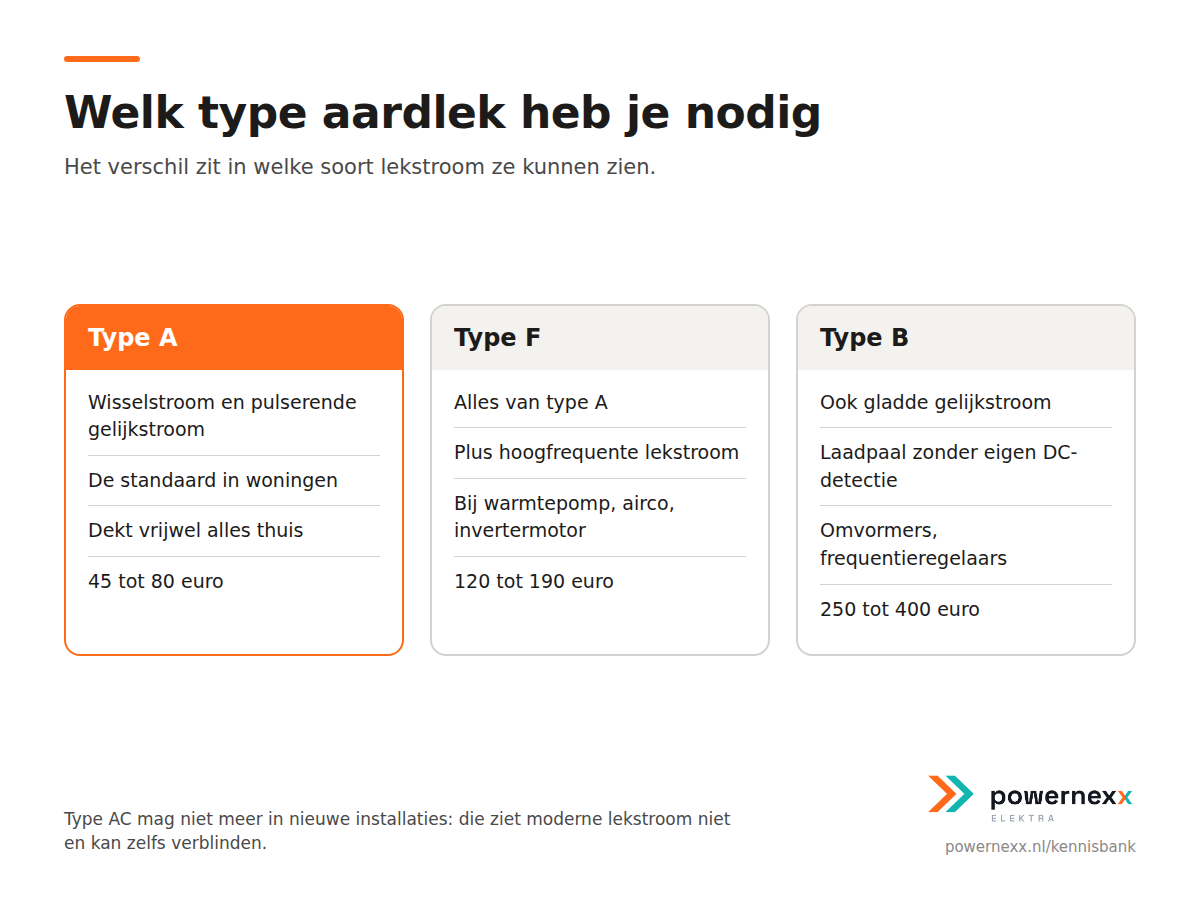
An RCD measures whether all the current going into your installation also comes back out. Where the types differ is in which kind of leakage current they can see.
| Type | Sees | What for |
|---|---|---|
| AC | Pure AC only | No longer allowed in new installations |
| A | AC plus pulsating DC | The standard in homes |
| F | Type A plus high-frequency components | With variable speed drives, some washing machines and air conditioners |
| B | Everything, including smooth DC | EV chargers without their own DC detection, inverters, medical equipment |
Why type AC is out
Type AC only sees pure AC. That was fine when appliances were little more than a motor or a heating element.
Modern appliances have switch-mode power supplies, and those distort the current. A pulsating DC component arises, and a type AC does not see it. Worse still: that component can magnetically saturate the core in the switch, so it no longer detects even the AC it should see. It then just sits there doing nothing.
That is why type AC has disappeared from new installations. You still find it a lot in existing consumer units, and that is one of the reasons to have an old unit looked at. See is my meter cupboard still safe.
Can you tell from the outside? Yes. Every RCD has a symbol and the type marking, usually small on the front. Type A has a small wave with a pulse symbol below it.
When do you need type B
Type B is the heaviest and the most expensive. You need it where smooth DC can leak away, and in a home that only happens in a few places:
- EV chargers without their own DC leakage detection. Some cars cause a DC component while charging.
- Inverters without an isolating transformer, in certain PV set-ups.
- Variable speed drives in workshops and on machines.
- Medical equipment and laboratory set-ups.
For the rest of a normal home, type A is enough.
What an EV charger with built-in detection changes
This is the point where you can save money, and that many installers do not look at.
Modern EV chargers often have built-in 6 mA DC leakage detection. If the charger has it, an ordinary type A in the meter cupboard is enough. Both Zaptec and Alfen have it as standard.
If that detection is not built in, a type B has to go in the consumer unit and you pay € 200 to € 350 extra.
Note: this must be stated explicitly in the charger's specification. With cheap chargers from the internet it is regularly missing, and then the charger is cheaper but the installation more expensive. Do the sums before you order. More on this in EV charger at home: single-phase or three-phase.
Is type F allowed too?
Type F sits between A and B. It does everything type A does, plus high-frequency leakage currents such as those from variable speed drives.
In homes you find it on circuits with a washing machine with an inverter motor, an air conditioner or a heat pump. It is not compulsory, but it prevents false tripping with that kind of appliance. If a circuit with a heat pump or air conditioner keeps tripping for no clear reason, this is one of the things I check.
Type F does not replace type B. For smooth DC you still need B.
What it costs
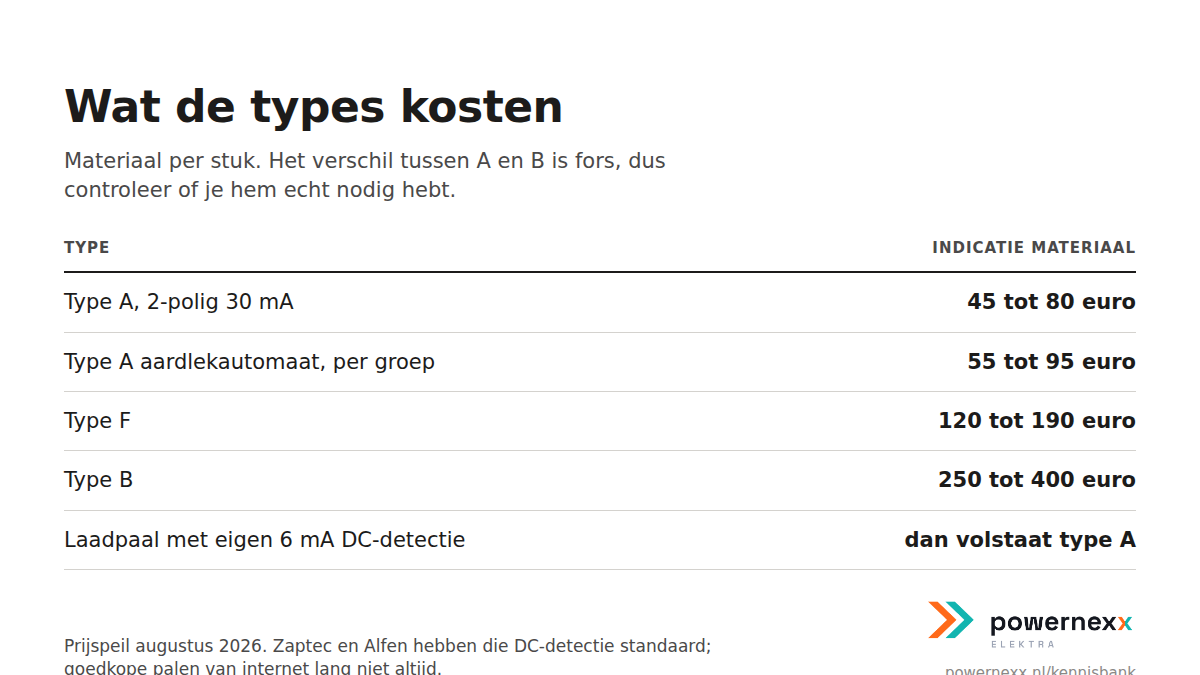
Material excl. VAT, prices as of August 2026:
| Type | Material estimate |
|---|---|
| Type A, 2-pole 30 mA | € 45 to € 80 |
| Type A RCBO, per circuit | € 55 to € 95 |
| Type F | € 120 to € 190 |
| Type B | € 250 to € 400 |
So the difference between A and B is hefty, and that is exactly why it pays to check whether you really need one. Full consumer unit prices on consumer unit replacement costs.
What I fit as standard
Type A RCBOs for all ordinary circuits. One module per circuit, breaker and RCD in one, so with a fault never more than one circuit goes off at a time.
Type A for the EV charger circuit, provided the charger has 6 mA DC detection. If not, type B, and then I tell you beforehand what that costs.
Type F where there is a frequency-controlled appliance on the circuit and there has been unexplained tripping before.
Type B only where it really has to be. I do not fit it as standard, because that is hundreds of euros for protection that most homes do not use.
From my own work
At a home in Heerlen the customer had bought an EV charger online that was € 180 cheaper than a Zaptec. Reading the specification showed it had no 6 mA DC detection. So a type B had to go in the consumer unit: € 280 extra plus two modules of space that were not there. Net, the cheap charger was more expensive, and the consumer unit also had to be extended.
When to call an electrician
- You still have type AC in your consumer unit
- You are not sure whether your EV charger has DC detection and whether you need a type B
- A circuit with a heat pump or air conditioner trips for no clear reason
- You have a quote that includes type B and you want to know whether that is justified
That last one comes up regularly. Send me the quote and the type of EV charger, and I will look at it free of charge.
Want to know how your consumer unit is doing now? I measure that during an electrical inspection. If it is urgent, go to the fault service. Otherwise: request a quote.
Frequently asked questions
Can I tell the type from the outside?
Yes. The front of every RCD shows the type marking with a symbol, usually in small print next to the test button.
Is type B compulsory with every EV charger?
No. If the charger has built-in 6 mA DC leakage detection, type A is enough. Zaptec and Alfen have it as standard.
Can type F be used instead of type B?
No, not for smooth DC. Type F covers high-frequency leakage current, not what type B covers.
What is the cost difference between type A and type B?
Material about € 200 to € 350, plus a type B takes up more modules in the consumer unit.
Can type AC stay in my existing consumer unit?
An existing installation may stay as it was installed. But type AC does not reliably see modern leakage currents, so when the consumer unit is replaced it comes out.
Do I need a type B for solar panels?
Not always. It depends on the inverter. Many inverters have their own monitoring, so type A is enough. See solar panels and your consumer unit.
Further reading
Is my meter cupboard still safe? 10 things you can see yourself
Ten things you can see yourself without unscrewing anything. If you recognise three or more, it is time for a chat.
How old is my installation really: these are the signs
Cloth-covered wiring, no RCD, screw-in fuses and unearthed two-pin sockets: each feature tells you something about the year it was built and the risk.
Testing your RCD: do this twice a year
Thirty seconds' work, twice a year. And the honest story about what that test button does and above all does not prove.
Questions and comments
Ask your question below. Ask before 17:00 on a working day and you get an answer from Kevin himself the same day. No account needed, and your email address does not appear on the site.