
Short answer
An arc fault detection device, also called AFDD or arc fault detection, recognises the electrical pattern of an arcing or smouldering connection and switches off before a fire starts. Your RCD and your breaker do not see that kind of fault. Count on € 90 to € 180 each. Worthwhile for bedrooms, lofts, timber structures and wherever people sleep who cannot escape quickly.
The gap in your protection
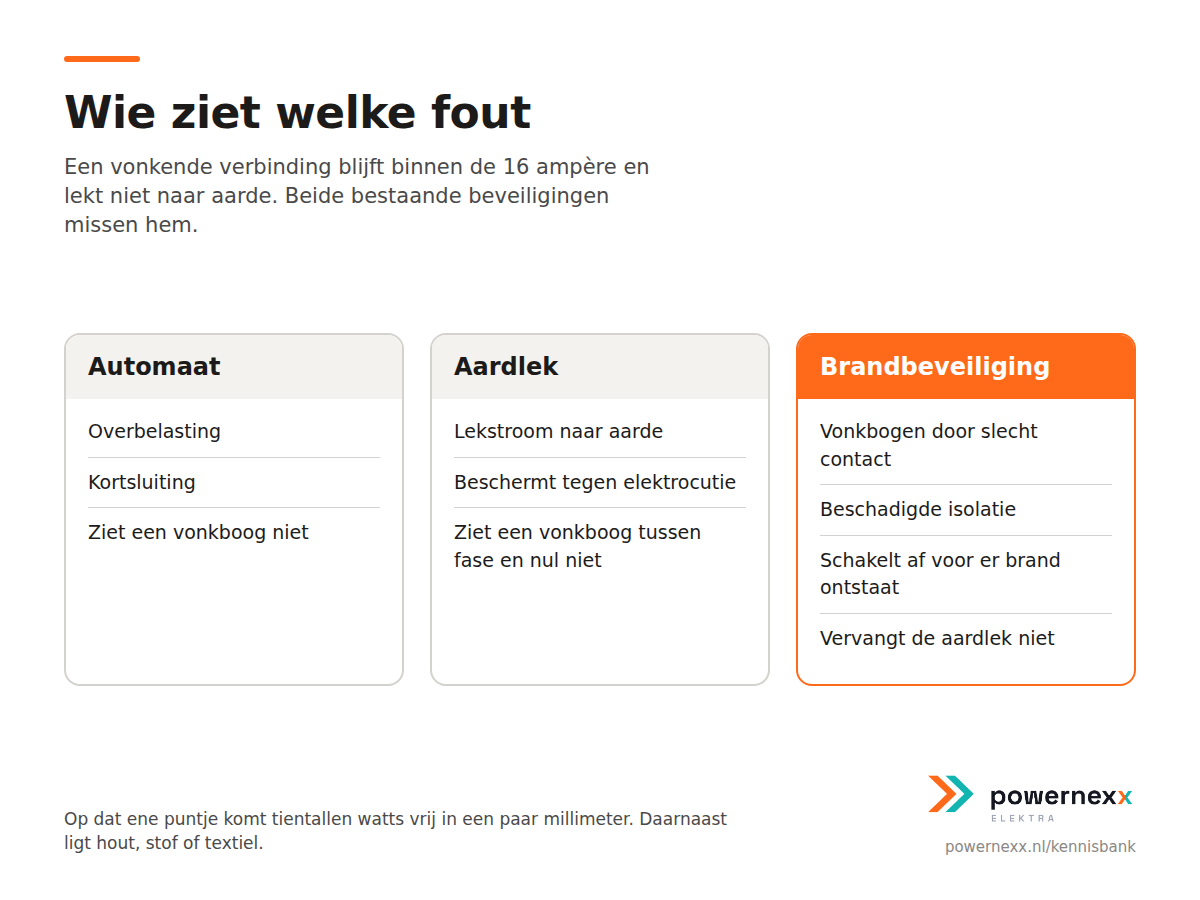
A normal consumer unit has two kinds of protection, and together they do not cover everything.
| Component | Protects against | Does not see |
|---|---|---|
| Circuit breaker (MCB) | Overload and short circuit | An arcing connection at normal current |
| RCD | Leakage current to earth | An arc between live and neutral |
| AFDD | Arcs from poor contact or damaged insulation | Overload (unless combined) |
Say a plug is half in the socket, or there is a break in an extension lead behind the sofa, or a screw once nicked the insulation of a cable. A small arc forms at that point. The current stays within 16 amps, so the breaker notices nothing. Nothing leaks to earth, so the RCD notices nothing.
Meanwhile, tens of watts are released at that one tiny point, in an area of a few millimetres. Temperatures well above hundreds of degrees. If there is insulation, dust, wood or fabric next to it, it smoulders and eventually burns.
That is exactly the gap an AFDD closes.
How it works
An arc produces a characteristic high-frequency pattern in the current. The AFDD continuously analyses the current waveform and recognises that pattern.
The tricky part is telling a dangerous arc apart from the normal sparks of everyday use: a light switch being flicked, the brushes of a drill, a vacuum cleaner motor. That is why there is quite a bit of signal processing inside, and why they cost what they do.
Early generations suffered from false trips with drills and old tools. That has greatly improved in the current generation, but it remains a point to watch in workshops with old machines.
Where it really makes sense
I do not fit them everywhere as standard, because then a consumer unit becomes unaffordable. I do in these places:
Strongly recommended:
- Bedrooms. You are asleep, you smell nothing, the smoke alarm only goes off once there is already a fire.
- Lofts with a timber structure. Lots of wood, lots of dust, often old cabling, and nobody goes up there.
- Timber-frame homes or homes with a lot of wood in the structure.
- Rooms where people sleep who cannot escape quickly: care homes, rented rooms, flats for the elderly.
- Listed buildings. Irreplaceable, and the cabling is rarely new.
- Spaces with a lot of combustible material stored.
Less worthwhile:
- Outdoor lighting and garden circuits
- Circuits with fixed equipment in a brick room, such as a washing machine in a utility room with a tiled floor
- A circuit that only feeds an EV charger with a short cable on an outside wall
Take care with:
- Workshops with old power tools. Test it before you close up the consumer unit.
Is it compulsory?
For homes in the Netherlands it is not generally compulsory at the moment. In some building uses and certain new-build situations, arc fault detection does come up as a requirement or a strong recommendation, and the discussion about it is ongoing in the standards committees.
What I say about it: do not be guided by "it is not required, so do not do it". It is a relatively cheap measure in exactly the place where a house fire is most deadly, namely where people sleep. For your project, always check the current state of NEN 1010 and the Bouwbesluit (Dutch Building Decree), because this is a subject that is changing.
What it costs
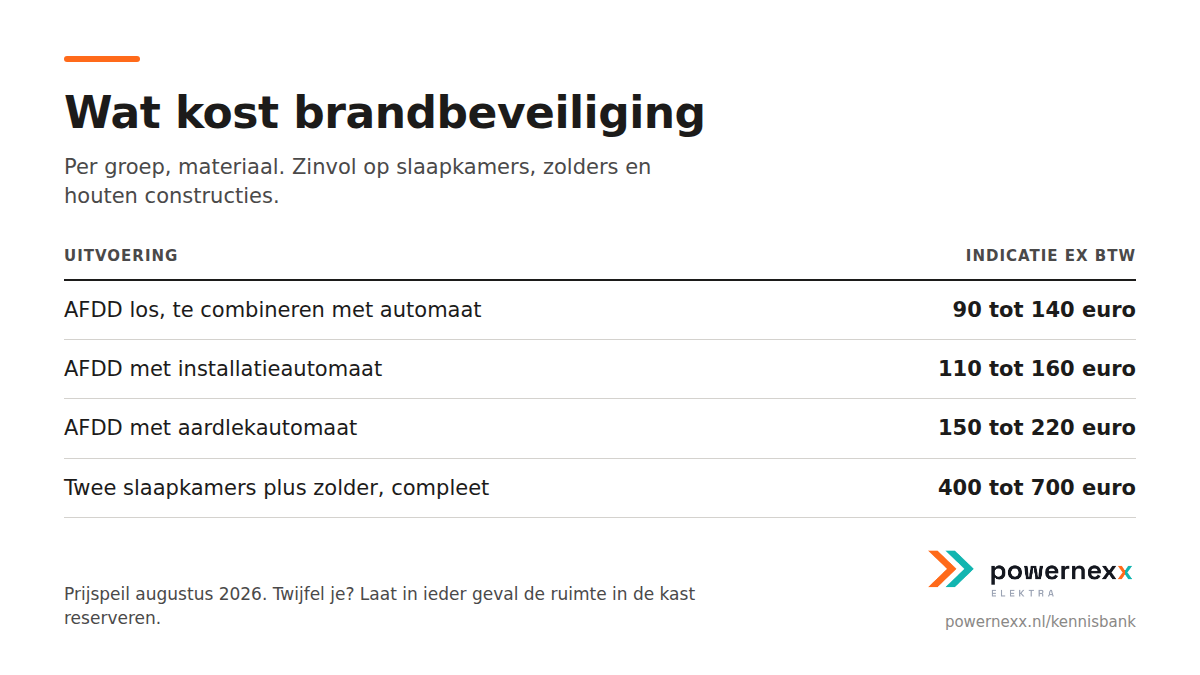
Prices excl. VAT, as of August 2026.
| Version | Material estimate |
|---|---|
| AFDD on its own (must be combined with a breaker) | € 90 to € 140 |
| AFDD combined with a circuit breaker | € 110 to € 160 |
| AFDD combined with an RCBO | € 150 to € 220 |
| Modules | 2 to 4 each |
For a home where you protect two or three bedroom circuits and a loft circuit, you are looking at € 400 to € 700 extra with a new consumer unit. That is a real amount, and it is up to the customer to decide whether it is worth it. The rest of the consumer unit price is on consumer unit replacement costs.
What I do say: if you are having a new consumer unit fitted and you are unsure, at least have the space reserved in the unit. Adding them later can then be done without opening up the whole unit.
What it is not
Not a replacement for your RCD. An AFDD does not protect against electrocution. The RCD is still needed, always. And you keep on testing.
Not a replacement for your smoke alarm. Smoke alarms are compulsory in every home and will stay so. The AFDD tries to prevent a fire starting, the smoke alarm warns you if it happens anyway.
No solution for poor cabling. If your installation is old and worn, the AFDD is a sticking plaster. Then replacement is the real solution.
Testing
Every AFDD has a test button. Just like the RCD: press it twice a year, it should drop out. Some models also have a self-test and an indicator LED that shows what the last reason for tripping was. That is very handy when looking for the cause.
If an AFDD keeps tripping without you being able to find anything, there really is an arcing connection somewhere. That is not something to ignore, nor something to solve by replacing the AFDD with an ordinary breaker.
From my own work
In a new-build timber-frame home in Limburg I put the four bedroom circuits and the loft circuit on AFDDs. It cost the customer about € 600 extra on a consumer unit of € 1.700. His reasoning: in a timber frame a fire develops faster and the children are upstairs. I thought that was a good call, and that is how the conversation should go: not a box-ticking exercise but a choice based on the situation.
When to call an electrician
With a new consumer unit, if you want to know whether it suits your situation. And if you have an AFDD that keeps tripping for no clear reason, because that is almost always a real fault that can be found with a thermal imaging camera and testing.
If you first want to know how your installation is doing, an electrical inspection is the right starting point. If it is urgent, go to the fault service.
Frequently asked questions
What is an AFDD?
Arc Fault Detection Device, in Dutch brandbeveiligingsschakelaar or vlamboogdetectie. It recognises the pattern of an arcing connection and switches off before a fire starts.
Is an AFDD compulsory?
In homes in the Netherlands not generally at the moment. In certain building uses and new-build situations it does come up as a requirement, and the standards are changing.
Does an AFDD replace my RCD?
No. The RCD protects against electrocution, the AFDD against fire from arcing. You need both.
Can an AFDD trip falsely?
With older generations that happened with old power tools with brushes. In the current generation that has greatly improved, but test it in a workshop.
Where is the best place for an AFDD?
On bedroom circuits, lofts, timber structures and anywhere people sleep who cannot escape quickly.
What does it cost per circuit?
Material between € 90 and € 220 depending on the version, plus 2 to 4 modules of space in the consumer unit.
Further reading
Is my meter cupboard still safe? 10 things you can see yourself
Ten things you can see yourself without unscrewing anything. If you recognise three or more, it is time for a chat.
How old is my installation really: these are the signs
Cloth-covered wiring, no RCD, screw-in fuses and unearthed two-pin sockets: each feature tells you something about the year it was built and the risk.
Type A, type B or type F RCD: which do you need
Type A is the standard. Type B only where DC leakage can occur, and that is less often than sellers say. Saves hundreds of euros.
Questions and comments
Ask your question below. Ask before 17:00 on a working day and you get an answer from Kevin himself the same day. No account needed, and your email address does not appear on the site.