
Short answer
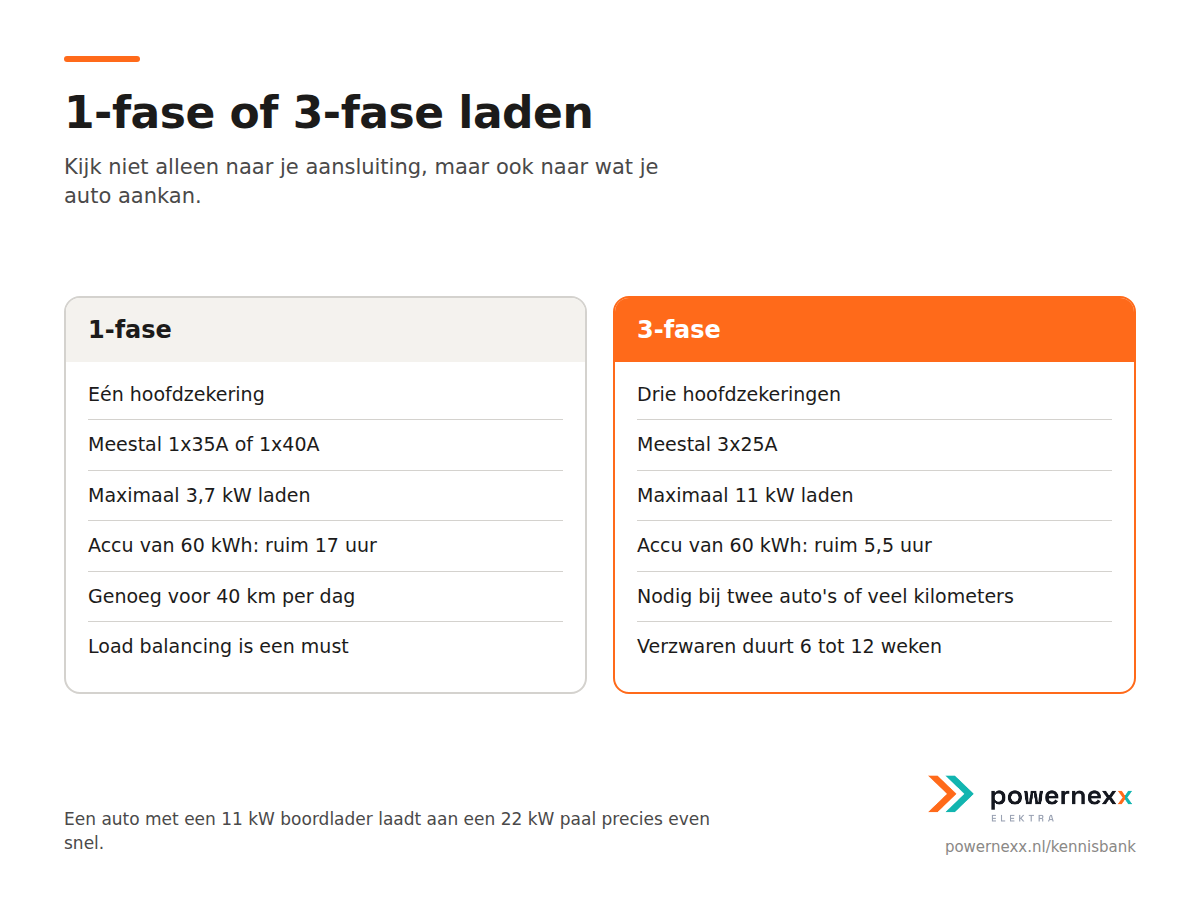
If you have a single-phase connection, you charge at up to 3.7 kW and your car is on the charger for about twelve hours for a full battery. With three-phase that goes to 11 kW and about four hours. The choice depends not only on your connection but also on your car: many cars only charge single-phase at home anyway, or at 11 kW at most. A separate circuit with its own RCD protection is always mandatory.
First: what do you have now
Look in the meter cupboard at the main fuses under the meter.
- One fuse (sometimes with a separate neutral): single-phase connection, usually 1x35A or 1x40A. A maximum of about 8 to 9 kW for your whole house.
- Three fuses side by side: three-phase connection, usually 3x25A. A maximum of about 17 kW.
The smart meter shows it too. With a three-phase meter you see three phase voltages in the display as you scroll through the menus.
What your car can actually do
This is the step most people skip, and then they buy a 22 kW charger for a car that uses 7.4 kW of it.
| Car (examples) | Maximum AC charging at home |
|---|---|
| Many small EVs and older models | 3.7 kW (single-phase 16A) |
| Many plug-in hybrids | 3.7 kW |
| A large share of current EVs | 11 kW (three-phase 16A) |
| A few models | 22 kW (three-phase 32A) |
Look in your manual under "onboard charger". A car with an 11 kW onboard charger charges exactly as fast on a 22 kW charger as on an 11 kW one. You then pay for power that is never used.
The reverse is also true: an EV charger is more future-proof than your car. If you have a single-phase car now but will change in three years, a three-phase charger on a three-phase connection is the more sensible purchase. The charger lasts fifteen years, the car four.
How long it really takes
Work with: charging time in hours = battery capacity in kWh divided by charging power in kW, plus about ten percent loss.
| Battery | At 3.7 kW | At 11 kW |
|---|---|---|
| 40 kWh | just over 11 hours | almost 4 hours |
| 60 kWh | just over 17 hours | just over 5.5 hours |
| 77 kWh | 22 hours | 7 hours |
For most people this matters less than it seems. The average Dutch driver does about 40 kilometres a day, which is about 8 kWh. At 3.7 kW you top that up in just over two hours. Your car stands still for twelve hours at night.
Three-phase really pays off if: you drive a lot of kilometres, you charge two cars, you need to be able to charge at varying times, or you want to take advantage of short cheap periods on a dynamic energy contract.
Thinking about upgrading? Three-phase connection costs shows what the grid operator charges and how long the lead time is. Allow weeks, not days.
What needs to happen in the meter cupboard
This is not an option but a requirement. An EV charger always gets:
- Its own final circuit. Never piggybacking on an existing circuit, not even the garage circuit.
- Its own 30 mA RCD protection. Not shared with other circuits.
- The right cable cross-section for the length of the run. With a long cable to the back of the garden the cable gets thicker, otherwise you get voltage drop.
- An earth connection that is right. In older homes this regularly comes to light. Without a sound earth no EV charger is allowed.
If your consumer unit is already full, this usually goes together with replacing the consumer unit or extending it. That is not a sales pitch: squeezing an EV charger into a consumer unit with no space simply does not work.
The RCD debate: type A or type B
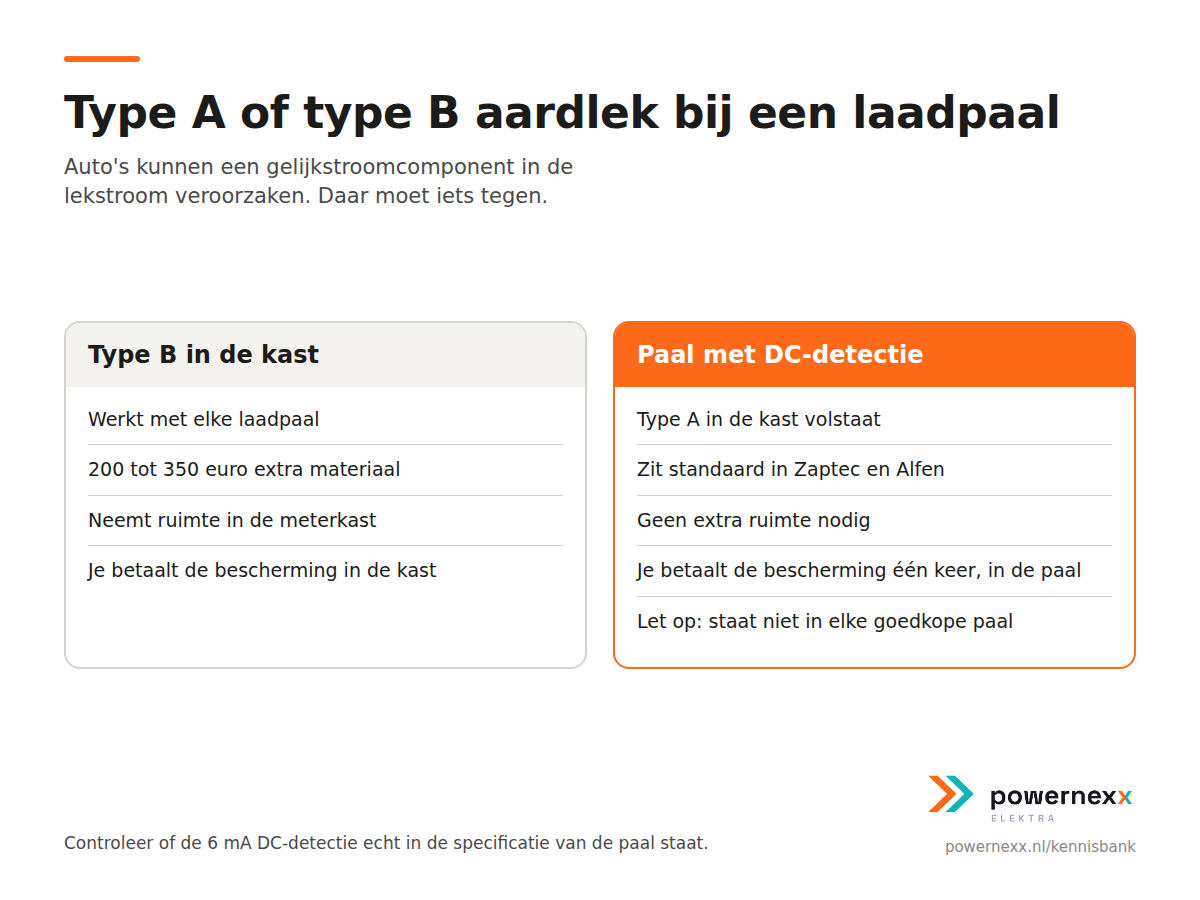
Electric cars can cause a small DC component in the leakage current while charging. An ordinary type A RCD cannot reliably detect it and can even be blinded by it.
There are two solutions:
- Type B RCD in the meter cupboard. Always works, but costs € 200 to € 350 extra in material.
- EV charger with built-in DC leakage detection (6 mA). Then a type A in the consumer unit is enough. Both Zaptec and Alfen have this as standard.
In practice I almost always choose option two. You pay for the protection once, in the charger, and not again in the consumer unit. Note: this must be stated explicitly in the charger's specification. With cheap brands from the internet that is far from always the case, and then you are stuck with a type B after all.
Has your RCD been tripping since the EV charger was fitted? That is often the reason. The step-by-step plan for an RCD that keeps tripping helps you rule out that it is something else.
Load balancing: why your main fuse holds
Say you have a single-phase 35A connection. You charge at 16A. That leaves 19A for the rest of the house. If you switch on your oven, washing machine, tumble dryer and kettle at the same time, your main fuse blows. And that is under the meter, so you cannot reset it yourself. That means a phone call to the grid operator and a wait.
Load balancing solves that. The EV charger measures via a sensor or via the P1 port of your smart meter how much the house is using, and adjusts the charging power to match. Is the oven on? Then the car charges a bit more slowly for a while. Oven off? Then it goes back up.
This should be standard in every installation. It costs little extra and prevents exactly the scenario that makes people say "since we got that EV charger the power keeps going off".
With solar panels you can go a step further: charging on surplus, where the car only charges with electricity you would otherwise feed back. What panels do to your meter cupboard is in solar panels and your consumer unit.
Before you start: is there grid capacity
In more and more neighbourhoods the grid is full and the grid operator no longer grants upgrades, or only in a year's time. You only find that out when you apply, and by then you are already planning. So first do the grid congestion check on your postcode. Then you know within a minute whether an upgrade is possible in your street at all, and whether you have to solve it with load balancing.
What it costs
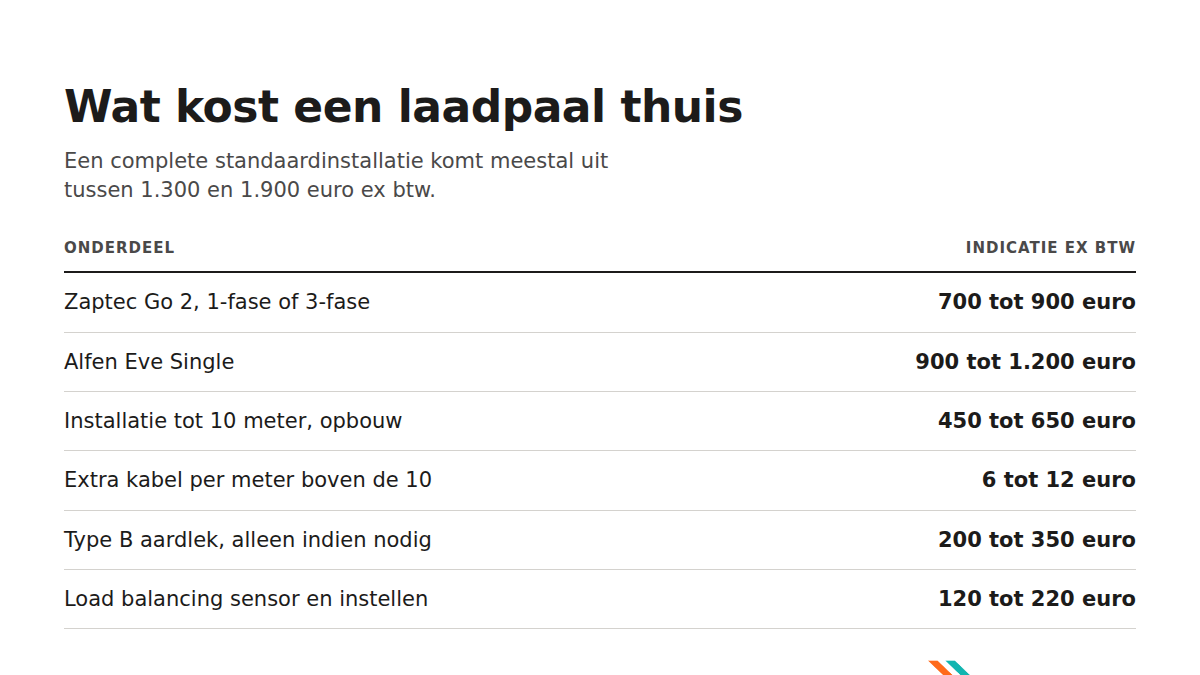
Prices excl. VAT, as of August 2026. Call-out charge € 59,99 excl. VAT, the same fixed rate nationwide.
| Item | Indication |
|---|---|
| Zaptec Go 2, single-phase or three-phase | € 700 to € 900 |
| Alfen Eve Single | € 900 to € 1.200 |
| Standard installation (up to 10 metres, surface-mounted) | from € 657 |
| Extra cable per metre above 10 metres | € 6 to € 12 |
| Digging or a lead-through in the outside wall | By quote |
| Type B RCD (only if the charger has no DC detection) | € 200 to € 350 |
| Load balancing sensor and configuration | € 120 to € 220 |
A complete installation, charger and work together, usually comes to between € 1.500 and € 2.500 excl. VAT. A Zaptec Go 2 including installation is a fixed € 2.396 including VAT. A more detailed breakdown is on EV charger installation costs.
The five questions I ask before a quote
If you answer these in advance, I can usually give a price within a day without coming out:
- Which car do you drive, and what is its maximum AC charging power?
- Single-phase or three-phase connection? (A photo of the main fuses is enough.)
- How many metres are there between the meter cupboard and the spot where the charger will go?
- Does that route run indoors, along the outside wall or through the garden?
- How many free modules are there in your consumer unit? (Photo with the door open.)
Send those five via WhatsApp and you will soon have clarity.
From my own work
At a house in Sittard another firm had fitted an EV charger without load balancing, on a 1x40A connection. Every time the dishwasher and the tumble dryer ran at the same time while the car was charging, the main fuse blew. The grid operator had to come out three times. The solution was an afternoon's work: a current sensor round the main cable and activating balancing in the charger's app. Nothing has gone wrong since, and charging takes on average twenty minutes longer per night.
When to call an electrician
I am a certified Zaptec and Alfen partner. That means the warranty and firmware support go through the manufacturer as they should, and that I can configure the charger in the back office.
Exactly what happens during an installation is on EV charger installation. Ready to go: request a quote.
Frequently asked questions
Can I connect an EV charger to my existing circuit?
No. An EV charger draws full power for hours and therefore always needs its own final circuit with its own RCD protection.
Do I need to upgrade to three-phase for an EV charger?
Usually not. With load balancing single-phase charging works fine for daily use. Upgrading only pays off if you drive a lot of kilometres, charge two cars or also have a heat pump. Do check first with the grid congestion check whether an upgrade is possible in your street.
Do I need a type B RCD?
Only if your EV charger does not have built-in 6 mA DC leakage detection. Zaptec and Alfen have that as standard, so then type A is enough.
Can I fit an EV charger myself?
Fitting the housing to the wall perhaps, connecting it no. And with most manufacturers the warranty lapses without an installation certificate from a registered electrician.
Does an EV charger work with solar panels?
Yes, and with Zaptec and Alfen you can set it to charge only on surplus. That becomes more interesting as the net metering scheme ends.
How long does the installation take?
A standard installation takes half a day. With digging or a long route through a crawl space it can become a full day.
What if the EV charger stops charging later or gives error messages?
Then it is a fault like any other. Via the fault service you choose a time slot yourself. With a charger I have fitted, I first look remotely in the back office; often that is enough.
Further reading
Which cable to the EV charger, and what the distance does
The further the charger is from the meter cupboard, the thicker the cable has to be. That is usually the item that decides the price.
Load balancing: why your main fuse can cope after all
Without load balancing the car keeps charging at full power while the oven and the tumble dryer are on too. With load balancing the car automatically charges more slowly.
Which RCD protection belongs with an EV charger
An EV charger can produce a DC fault that an ordinary RCD is blind to. It needs protection that can see it.
Questions and comments
Ask your question below. Ask before 17:00 on a working day and you get an answer from Kevin himself the same day. No account needed, and your email address does not appear on the site.