
Short answer
An average family home today has twelve to sixteen circuits. You do not work out the exact number with a rule of thumb but room by room: anything with a heating element or that draws full power for a long time gets its own circuit. Then add at least four empty modules as spare.
Why three circuits are no longer enough
A home from 1975 had three to five circuits and that was plenty. There was a lamp, a TV and a fridge.
What has been added since: induction cooking (7.4 kW), dishwasher, tumble dryer, microwave, air fryer, Quooker, EV charger, heat pump, air conditioning, home office, solar panels. Each circuit is 16 amps, roughly 3,680 watts. Two heavy appliances on one circuit and you are already at the limit.
So it is not only about whether your connection can cope (see single-phase or three-phase), but also about how you divide things up.
Work it out room by room
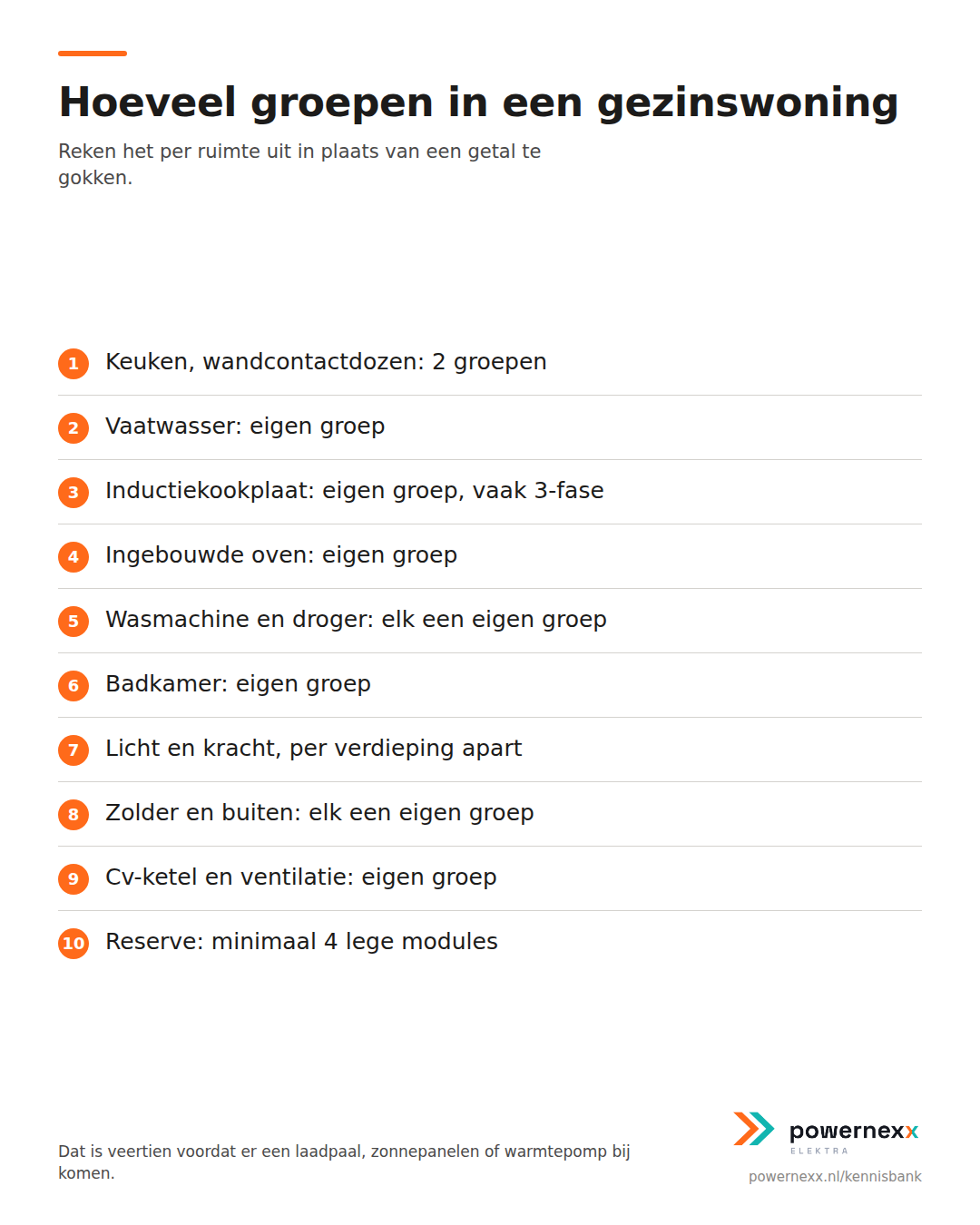
Walk round your house and add it up. This is the layout I use as standard in a family home:
| Room or appliance | Circuits |
|---|---|
| Kitchen, sockets | 2 |
| Dishwasher | 1 |
| Hob (induction) | 1, often two-phase or three-phase |
| Oven, built-in | 1 |
| Washing machine | 1 |
| Tumble dryer | 1 |
| Bathroom | 1 |
| Lighting ground floor | 1 |
| Power ground floor | 1 |
| Lighting upstairs | 1 |
| Power upstairs | 1 |
| Loft | 1 |
| Outdoors and garden | 1 |
| Boiler and ventilation | 1 |
That makes fourteen before you have anything special. Add an EV charger and it becomes fifteen. Solar panels: sixteen. A heat pump: seventeen.
Want to work this out for your situation instead of copying a list? Go through the circuit planner. It asks what you do in each room and comes up with a number, spare included.
Circuits are not the same as modules
This is where people get it wrong when ordering a consumer unit.
A consumer unit is measured in modules of 18 mm. But not every module is a circuit:
- The main switch takes 2 modules (single-phase) or 4 (three-phase).
- Each RCD takes 2 modules and protects up to four circuits.
- Each circuit breaker takes 1 module.
- An RCBO takes 1 module on single-phase and is circuit breaker and RCD in one.
Do the sum: fourteen circuits with separate RCDs means four RCDs (because four circuits each at most), so 8 modules for the RCDs, 2 for the main switch and 14 for the breakers. That is 24 modules together, and then you have zero spare.
More on this in meter cupboard dimensions.
The spare capacity that costs next to nothing now
This is the advice that saves the most money and is given the least.
Add at least four empty modules. When the consumer unit is being fitted anyway, a slightly larger enclosure costs you a few tens of euros. If you are four modules short in three years, it means a new consumer unit, a day without power and another call-out charge.
Think ahead about what might come:
- An EV charger, even if you do not have an electric car yet
- A heat pump, certainly if your boiler is getting on
- A home battery, because that is becoming more interesting now net metering is ending
- Air conditioning in the bedroom
- A workspace or workshop in the garage
How many RCDs
The standard allows a maximum of four final circuits per RCD. With fourteen circuits that means at least four.
In practice that is on the tight side. If an RCD trips, four circuits go off at once, and you are left with half floors in the dark while one appliance is leaking.
The alternative is RCBOs: one module that is circuit breaker and RCD in one. More expensive in material, but then never more than one circuit goes off at a time and the classic neutral fault cannot happen. They are my standard. See connecting an RCD.
More circuits does not mean more capacity
An important misunderstanding. Circuits divide your installation, they do not make it bigger.
With a 1x35A connection you have roughly 8 kW, whether you have six or sixteen circuits. What more circuits do achieve: they stop one circuit from being overloaded, and make sure as little as possible goes off when there is a fault.
If you are reaching the limit of your connection, that is a different conversation: see upgrading your connection. And first check with the grid congestion check whether an upgrade is possible in your street.
During a renovation
Run one extra empty conduit to the loft and one to the garage while the walls are open anyway. It costs next to nothing, and saves cutting into a tiled wall later.
Also think about where the circuits go, not just how many there are. Lighting separate from power, the kitchen split in two, outdoors separate. That is worked out in separate circuits.
What it costs
The number of circuits is only part of the price. Prices as of August 2026.
The package I fit most often is a three-phase consumer unit with 12 circuits, 3 RCDs, a main switch, a power circuit and a doorbell transformer, fully fitted and with a test report: € 2.700 including VAT (€ 2.231 excluding). The full breakdown is on cost of consumer unit replacement.
| Consumer unit | Indication excl. VAT |
|---|---|
| 12 circuits, three-phase, the package above | € 2.231 |
| Extra circuit in an existing consumer unit with space | € 250 to € 400 |
Going from eight to twelve circuits only adds a few hundred euros in material. Coming back later for four circuits costs more.
For a single-phase home the price depends so much on the number of circuits, the condition of the existing wiring and the space in the consumer unit that a price range tells you nothing. Send a photo of your meter cupboard with the door open and you will have an accurate price within a day. A quote costs nothing, even if you do not accept it.
From my own work
At a house in Ulestraten I came to add an EV charger circuit. There was exactly one module free, because the consumer unit had been made to measure, tightly, three years earlier. It just fitted for the EV charger, but the heat pump that came a year later no longer fitted. Then the whole consumer unit had to come out after all. Four extra empty modules would have cost about forty euros on that first consumer unit.
When to call an electrician
During a renovation or a new build, at the stage when the drawing is ready but nothing has been cut into yet. Then a good layout costs next to nothing.
And if you are not sure whether your current consumer unit is still adequate: send a photo with the door open via WhatsApp, I will count along and tell you whether it will get tight. If the consumer unit has to go, read how that day goes in consumer unit replacement. Ready to go: request a quote.
Frequently asked questions
How many circuits does an average home need?
Twelve to sixteen for a family home, plus spare. Work it out room by room instead of sticking to a number.
Are more circuits always better?
Up to a point. More circuits means less goes off with a fault and less chance of overload. It does not increase your connection capacity.
How many empty modules should I keep spare?
At least four. That costs a few tens of euros now and saves a complete consumer unit swap later.
How many circuits can go behind one RCD?
A maximum of four final circuits. With fourteen circuits you therefore need at least four.
Can I add circuits later?
If there are modules free and there is RCD capacity left, yes. If the consumer unit is full, it is a replacement or an add-on unit.
Do I get more power with more circuits?
No. Your connection capacity determines how much power you have. Circuits only divide it more cleverly.
Further reading
Which consumer unit brand should you choose? Hager, Schneider, ABB and the rest
All brands are equally safe. The difference is whether you can still add a circuit in eight years' time, and that is exactly what nobody tells you.
Connecting an RCD: how it should be done and why it is not a DIY job
Where it sits in the chain, how it works and the neutral fault that explains nine out of ten RCDs that trip at random.
Meter cupboard dimensions: what fits and what are the requirements?
The standard sizes, how many modules really fit and the three things you need to measure before you order a bigger consumer unit.
Questions and comments
Ask your question below. Ask before 17:00 on a working day and you get an answer from Kevin himself the same day. No account needed, and your email address does not appear on the site.