
Short answer
Replacement is needed if you have no RCD, if you still have ceramic fuses, or if you have too few circuits for what you want in your home. A complete three-phase consumer unit with twelve circuits, three RCDs, a power circuit and a doorbell transformer costs € 2.700 including VAT, fitted and with a test report. A single-phase home is priced by quote, because there the condition of the existing installation matters most. The job usually takes one day and you are without power for about four hours.
When it really has to be done
There are three categories, and it is important that you know which one you are in. Not every old consumer unit has to go straight away.
Category 1: replace now
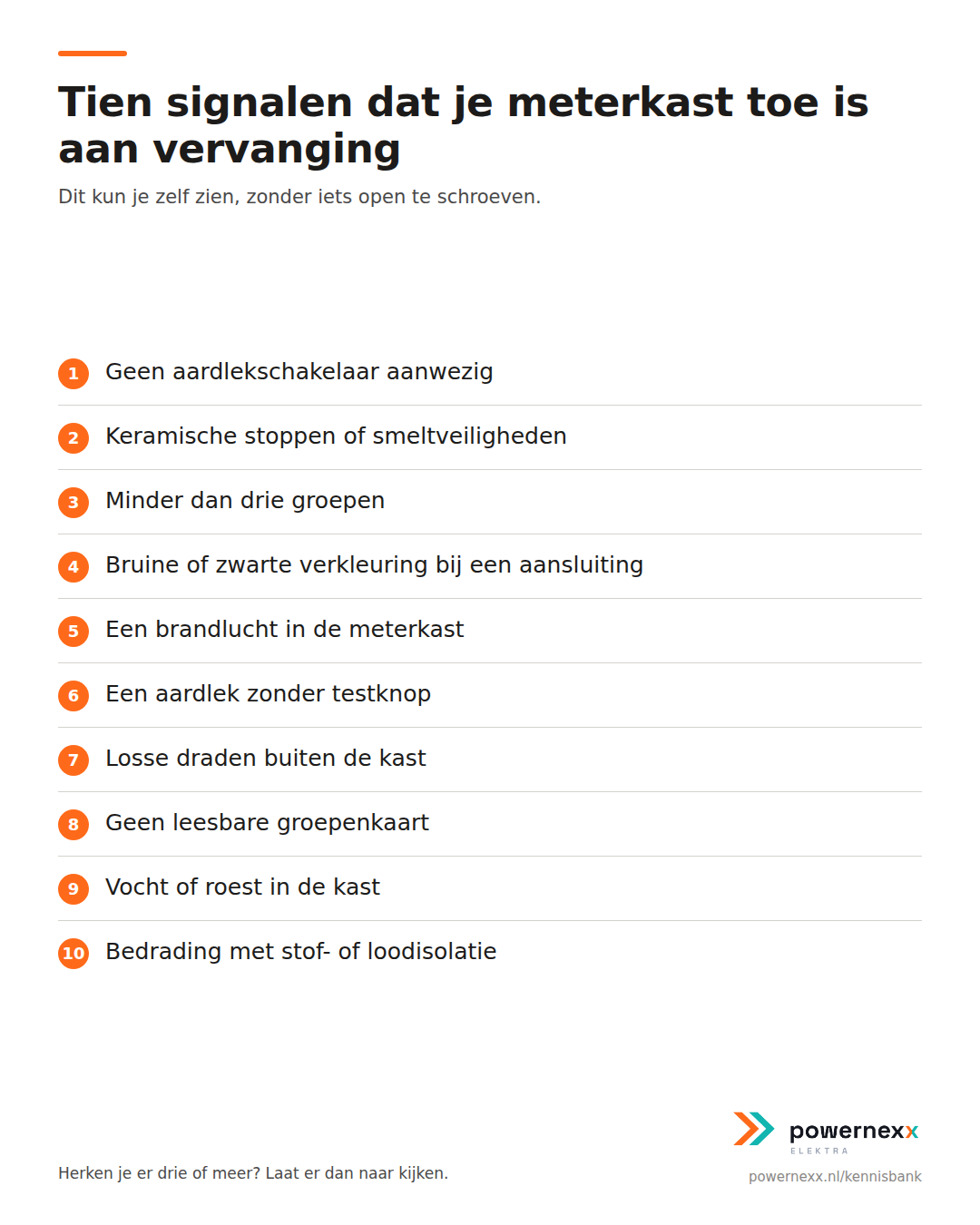
- No RCD. Consumer units from before 1975 often do not have one. Without an RCD there is no protection at all against leakage current through a person. This is the only point where I say: do it this year.
- Ceramic fuses or rewirable fuses. They do not blow fast enough for modern equipment, and people routinely put fuses in that are too heavy.
- Brown or black discolouration around a connection, or a burning smell. That is a connection running hot. Call the same day.
- Wiring with cloth or lead insulation. You still come across it in houses from before 1960. The insulation crumbles.
Category 2: replace as soon as you are doing something anyway
- You have two to four circuits and you want induction cooking, an EV charger or a heat pump. You will not manage with that.
- Six or more circuits hang behind one RCD. Four is the maximum allowed. The practical result: if something trips, half your house is in the dark.
- The consumer unit is full and there is no room to add a circuit.
- You are going to renovate, the bathroom or kitchen is being redone. That is the moment.
Category 3: not needed yet
- The consumer unit is from the nineties, has a working RCD, eight or more circuits and there is still space. Then there is no reason at all to replace it. Do not let anyone talk you into it.
- A consumer unit that looks ugly but is technically sound. Electricity does not care about looks.
What exactly is replaced
People say "replacing the meter cupboard", but that is not quite right. The meter cupboard is the space. What I replace is the consumer unit: the distribution board with the main switch, RCDs and breakers.
What is yours, and so is replaced by me:
- the consumer unit with all its components
- the wiring from the consumer unit to the circuits, from the point where the existing installation begins
- the earth connection and the main earth bar
- the circuit chart
What is not yours, and so stays:
- the smart meter (that belongs to the grid operator)
- the service connection and the main fuses below it
- the supply cable from the street
That last point is why a grid operator is always involved as soon as you go from single-phase to three-phase. What that costs and how long you wait for it is on three-phase connection costs.
How the day goes
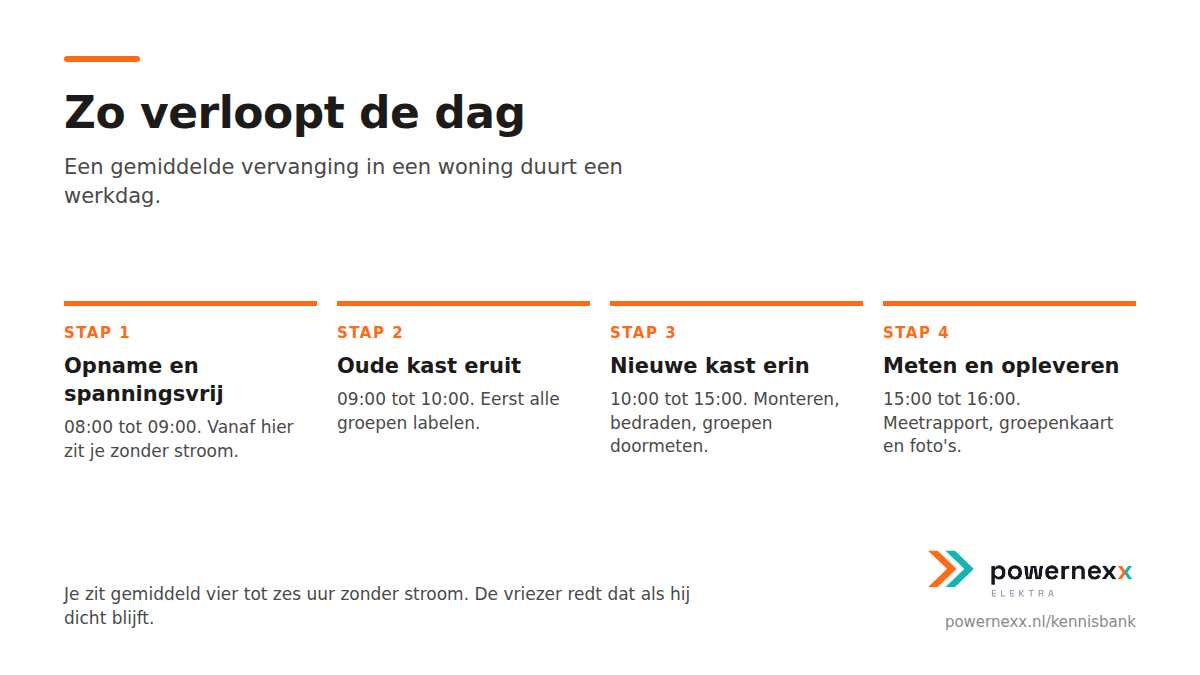
08:00 Arrival and survey. I go over the installation, check the earth connection and test the existing circuits. If there is anything I could not see on the photos, you hear about it now and not afterwards.
08:30 Isolating. From here on you are without power. Keep the freezer closed and it will easily last a day. If you want coffee or internet, set up an extension lead to the neighbours beforehand or charge your laptop.
09:00 Old consumer unit out. The existing circuits are labelled before anything is disconnected. That labelling is where sloppy work goes wrong.
10:00 New consumer unit in. Mounting, wiring, fitting the links. I work with Hager, because the busbars and components fit together well and you can easily extend later.
13:00 Connecting and testing the circuits. Each circuit gets its own connection and is tested. This is often where the real work comes to light: a circuit that turns out to go nowhere, or two rooms on one wire.
15:00 Tests and commissioning. Insulation resistance, earth electrode resistance, continuity of the protective conductor, and testing the RCDs for tripping time and tripping current.
16:00 Handover. Filling in the circuit chart, going through everything with you, photos on the job sheet. You get a handover report with the test results. You want that, also for your insurance.
What it costs
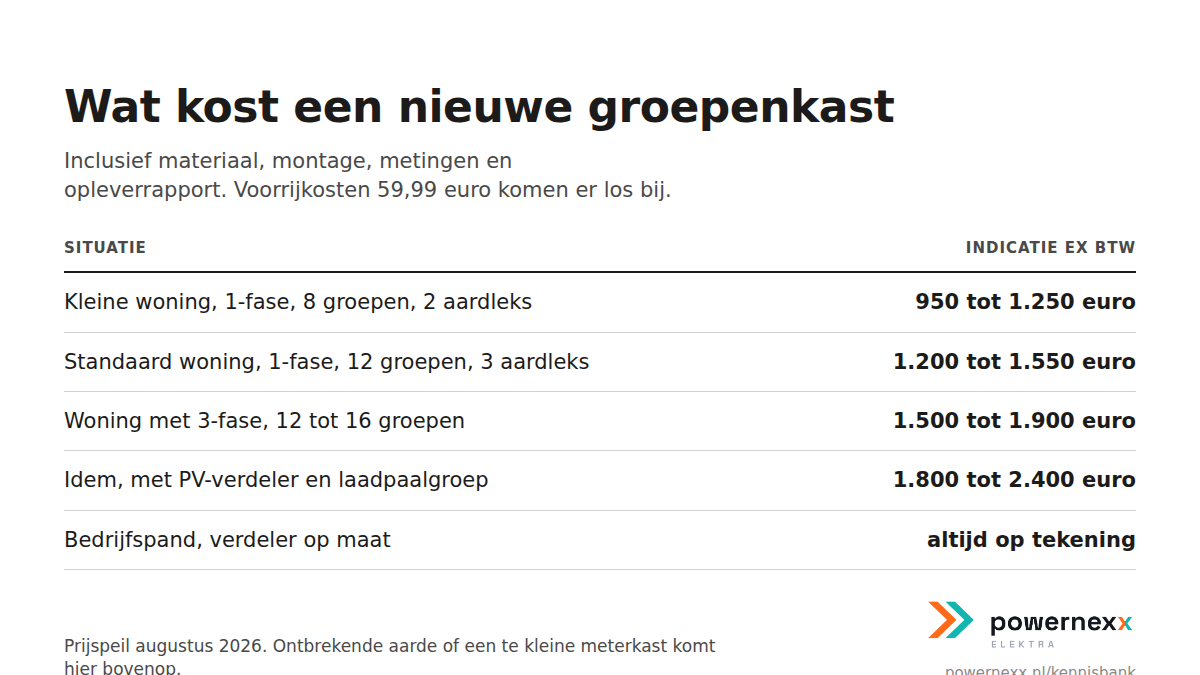
Prices excl. VAT, as of August 2026. For private homes older than two years the low VAT rate often no longer applies to the labour part, so allow for 21 percent unless agreed otherwise.
| Situation | Indication excl. VAT |
|---|---|
| Home with three-phase, 12 circuits, complete package | € 2.231 |
| Same, including a PV distribution board and EV charger circuit | on quotation |
| Commercial premises, custom distribution board | Always on drawing and quote |
What is included in that price
Material (consumer unit, main switch, RCDs, breakers, wiring, earth bar), labour, the tests, the handover report and the circuit chart. The call-out charge of € 59,99 excl. VAT comes on top, and with me it is fixed, whether you are in Maastricht or in Groningen. The breakdown per item is covered in more detail on cost of consumer unit replacement, and how my hourly rate is made up you can read on what does an electrician cost.
What is not included, and what makes it more expensive
- Earth missing or inadequate. In older homes without an earth rod or with an earth connection via the water pipe, an earth electrode has to be driven in. Allow € 180 to € 350 extra.
- Circuits that no longer comply. If an existing circuit turns out to lead nowhere or to be unsafe, it has to be sorted out. You cannot see that in advance.
- Asbestos or a meter cupboard that is too small. Then it becomes a different conversation.
- Upgrading to three-phase. The grid operator's work is never in my quote, you pay that directly to them.
I say this explicitly because the trade is vague about it. A quote that nails everything down in advance without having seen the installation is usually a quote that leads to extra work later.
How many circuits to have fitted
Not the minimum. The price of an extra empty module in the consumer unit is negligible compared with coming back in three years.
Rule of thumb for a family home:
- kitchen: at least 2 separate circuits, plus 1 for the dishwasher
- induction hob: its own circuit, often two-phase or three-phase
- utility room: 1 for the washing machine, 1 for the tumble dryer
- bathroom: its own circuit
- per floor: 1 lighting and 1 power
- EV charger: always its own circuit with its own RCD
- solar panels: its own circuit, with a PV distribution board for multiple strings
- spare: at least 4 empty modules
Want to work this out for your home instead of following a rule of thumb? Go through the circuit planner. It asks what you do in each room and works out how many circuits you need, spare included.
Are you only short of space and is the rest of the consumer unit fine? Then sometimes it does not need to come out at all. Have a look at extending the meter cupboard first.
What you should get from your installer
At handover:
- A filled-in circuit chart, readable, showing what is really on each circuit.
- A handover report with test results: insulation resistance per circuit, earth electrode resistance, tripping times of the RCDs.
- Photos of the consumer unit open and closed.
- The invoice with a breakdown of materials and hours.
If you do not get that, ask for it. Without a test report you cannot prove after damage that the installation was in order at handover.
Can you do this yourself
Legally there is no ban in the Netherlands on private individuals doing installation work in their own home. In practice: no, and for three reasons.
- You are working right next to a supply that you cannot isolate. The cable from the main fuse to the consumer unit is always live.
- Without test equipment you cannot prove it is right. You do not measure insulation resistance with a multimeter from the DIY store.
- After a fire your insurer looks at who did the work. Work without demonstrable competence is a reason to refuse a payout.
From my own work
At a terraced house in Beek the quote was for a standard 12-circuit consumer unit. When we opened it up it turned out the previous owner had looped the bathroom circuit off the loft circuit, through a junction box in a wall that had since been tiled. Nobody could have seen that. The solution was a new cable run through the crawl space, four hours extra. I discuss that kind of thing on the spot before I carry on, never afterwards on the invoice.
When to call an electrician
Call if you are in category 1 or 2 above. If you are in category 3, I will simply tell you so and you have not bought anything.
Exactly what I do in a replacement, from survey to handover report, is on the service page consumer unit replacement.
Fastest route: send a photo of your meter cupboard with the door open and a photo of the meter itself via WhatsApp. Then I can see what type of connection you have, how many circuits there are and whether there is an RCD. Usually I can then give a price range without coming out.
If you first want to know what others think, read the customer reviews. Ready to go: request a quote. If you have a fault now and it cannot wait, go to the fault service and choose a time slot yourself.
Frequently asked questions
How long will I be without power?
Usually four to six hours. With a large consumer unit or if something comes up along the way, it can run to a full working day. The freezer copes fine as long as you keep it closed.
Does the grid operator need to be involved?
Only if something changes at the connection itself, so when upgrading or when moving the meter cupboard. Just replacing the consumer unit does not need it.
Can I have the consumer unit fitted somewhere else?
The consumer unit may be moved, the meter not just like that. Moving the meter is the grid operator's work and usually costs more than the whole consumer unit.
Is a new consumer unit mandatory when I sell my house?
No, there is no legal obligation. But buyers and estate agents ask about it more and more, and a building survey always flags a consumer unit without an RCD as a point of attention.
Why Hager and not another brand?
Because I work with it every day, the components fit together predictably and you can extend easily later. If you want another brand, that is fine. Mention it when you ask for the quote.
What happens to my old consumer unit?
I take it away and dispose of it. That is included in the price.
Can I have the rest of my installation inspected at the same time?
You can, and it is a logical moment. With an electrical inspection of your home I test all the circuits and you get a report with the test results. Useful for your insurer and when you sell.
I want a heat pump later. Should I take that into account now?
Yes. A heat pump needs its own circuit and sometimes a heavier connection. Include it in the number of circuits, that is almost free now and a consumer unit swap later. See heat pump connection.
Further reading
Which consumer unit brand should you choose? Hager, Schneider, ABB and the rest
All brands are equally safe. The difference is whether you can still add a circuit in eight years' time, and that is exactly what nobody tells you.
Connecting an RCD: how it should be done and why it is not a DIY job
Where it sits in the chain, how it works and the neutral fault that explains nine out of ten RCDs that trip at random.
Meter cupboard dimensions: what fits and what are the requirements?
The standard sizes, how many modules really fit and the three things you need to measure before you order a bigger consumer unit.
Questions and comments
Ask your question below. Ask before 17:00 on a working day and you get an answer from Kevin himself the same day. No account needed, and your email address does not appear on the site.