
Short answer
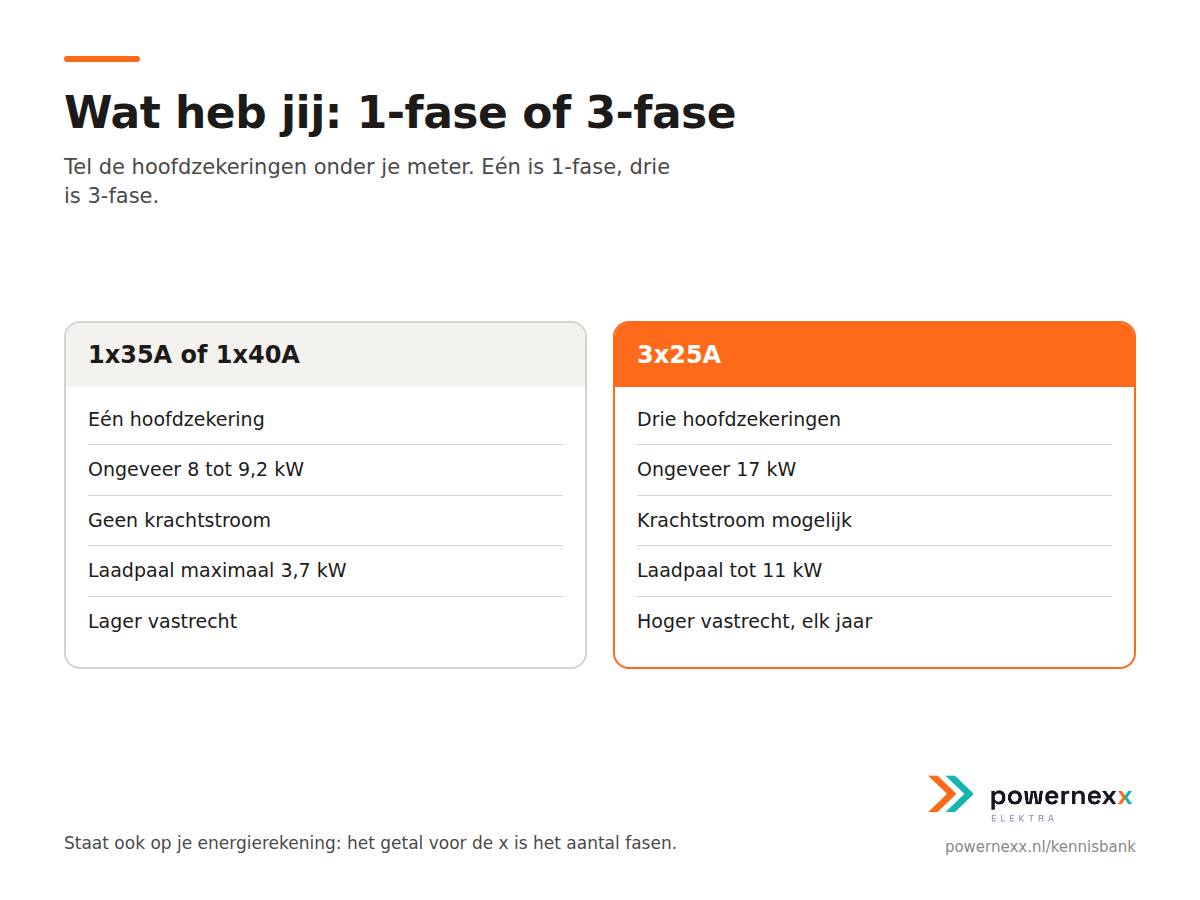
With single-phase one live supply comes into your house and you have roughly 8 kW available. With three-phase there are three, giving roughly 17 kW. You can see it in ten seconds: count the main fuses under your meter. One is single-phase, three is three-phase.
How to see in ten seconds what you have
Open your meter cupboard and look at the small box directly below or next to the electricity meter, usually with a seal on it.
- One thick fuse cartridge (sometimes with a separate pass-through for the neutral): single-phase.
- Three fuse cartridges side by side, often marked 3x25A: three-phase.
Can you not get to it, or is it behind a cover plate? Then look at your energy bill. It shows your connection capacity, for example "1x35A" or "3x25A". The number before the x is the number of phases.
What the difference means in practice
With single-phase all the current goes through one wire. The voltage is 230 volts. With 3x25A you have three wires that can each carry 25 amps, and between two phases you measure 400 volts. That last part is what people call three-phase power.
| 1x35A | 1x40A | 3x25A | |
|---|---|---|---|
| Phases | 1 | 1 | 3 |
| Maximum power | about 8 kW | about 9.2 kW | about 17 kW |
| Three-phase power possible | no | no | yes |
| EV charger maximum | 3.7 kW | 3.7 kW | 11 kW |
Why it is getting tight more and more often
Until about fifteen years ago single-phase was plenty for an average home. What has been added since:
- Induction cooking: a full induction hob can draw 7.4 kW. On 1x35A that is almost your whole connection.
- EV charger: 3.7 kW continuously, for hours on end. See EV charger at home: single-phase or three-phase.
- Heat pump: 1.5 to 4 kW, and in frosty weather exactly when you also want to cook. See heat pump connection.
- Air conditioning: 1 to 3 kW, often exactly when the sun is already loading your inverter.
Added together this goes over the 8 kW. And if your main fuse blows, you cannot replace it yourself. It is behind the seal and that is the grid operator's work.
When do you really need three-phase
Yes, really needed:
- Three-phase power for a machine in a workshop
- A three-phase induction hob that cannot be rewired
- Charging more than one car
- A larger heat pump combined with induction and an EV charger
Probably not needed, despite what you hear:
- Charging one car. With load balancing single-phase works fine for daily use.
- Solar panels up to about 5 kW. Above that three-phase does become more sensible, because otherwise all the feed-in is on one phase. See solar panels and your consumer unit.
- An ordinary home with induction, provided the cooking circuit is done properly.
Not sure? Go through the circuit planner. It asks what you do in each room and shows how much power you add up to.
The hidden cost difference
What people often forget: a three-phase connection has a higher standing charge from your grid operator than single-phase. That is tens of euros a year, every year, whether or not you use the capacity. Upgrading because it is "handy" therefore costs you money year after year.
The other way round: if you have three-phase but do not use it, you can sometimes downgrade. That can pay off if, for example, you have taken over a workshop without machines.
What an upgrade costs exactly and how long it takes is on three-phase connection costs. Also check first with the grid congestion check whether it is possible in your street at all; in more and more neighbourhoods the grid is full.
What is different in the consumer unit
A three-phase consumer unit has a 4-pole main switch (three phases plus neutral) and the circuits are divided over the three phases. That dividing is exactly where sloppy work goes wrong.
Dividing well means spreading the heavy users so that each phase carries roughly the same load. If the washing machine, tumble dryer and dishwasher are all on phase 1 and the rest spread out, phase 1 trips while the other two do nothing. That is a mistake you only see if someone actually measures at handover.
Ask about it at handover: what is the measured load per phase. With an electrical inspection I measure that as standard.
From my own work
At a house in Geleen the customer wanted to upgrade because the EV charger installer had said it was necessary. When I did the sums, a 1x40A connection with load balancing turned out to be perfectly adequate: the car did 12,000 kilometres a year and stood still for ten hours every night. The upgrade would have cost well over € 500 in grid operator charges plus a higher standing charge, for zero practical benefit.
When to call an electrician
If you are not sure whether your current connection is enough for what you are planning. That can usually be worked out in ten minutes and may save you an unnecessary upgrade.
Send a photo of your meter and of your main fuses via WhatsApp, plus what you are planning. Then I will tell you whether it fits. If it goes together with a new consumer unit, see consumer unit replacement.
Frequently asked questions
Can I see whether I have three-phase without opening the cupboard?
Yes. Your energy bill shows the connection capacity, for example 3x25A. The number before the x is the number of phases.
Is three-phase safer than single-phase?
No, not inherently. Both are equally safe if the installation is right. Three-phase just gives more capacity and a better spread of the load.
Do I need three-phase for three-phase power?
Yes. Three-phase power is by definition 400 volts between phases, and that only exists with a three-phase connection.
Will my energy bill go up with three-phase?
The standing charge from the grid operator is higher. Your consumption does not go up, only the fixed costs.
Can I go back from three-phase to single-phase?
Usually yes, via the grid operator. That can pay off if you do not use the capacity.
Is an upgrade always possible?
No. In neighbourhoods with grid congestion the grid operator sometimes does not grant an upgrade, or only in a year's time. First do the grid congestion check on your postcode.
Further reading
Which consumer unit brand should you choose? Hager, Schneider, ABB and the rest
All brands are equally safe. The difference is whether you can still add a circuit in eight years' time, and that is exactly what nobody tells you.
Connecting an RCD: how it should be done and why it is not a DIY job
Where it sits in the chain, how it works and the neutral fault that explains nine out of ten RCDs that trip at random.
Meter cupboard dimensions: what fits and what are the requirements?
The standard sizes, how many modules really fit and the three things you need to measure before you order a bigger consumer unit.
Questions and comments
Ask your question below. Ask before 17:00 on a working day and you get an answer from Kevin himself the same day. No account needed, and your email address does not appear on the site.