
Short answer
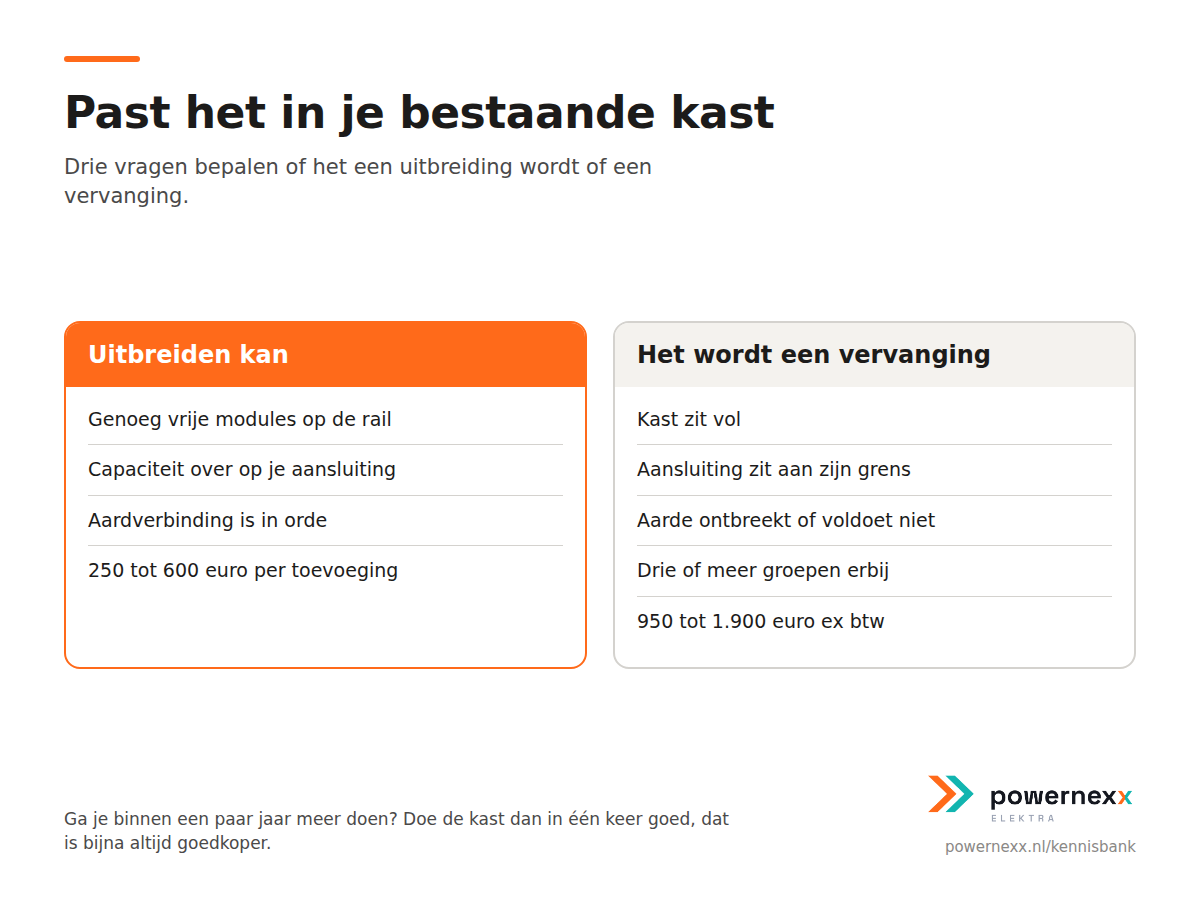
Each of these four goes on its own circuit, and an EV charger also on its own RCD protection. Whether it fits in your existing consumer unit depends on three things: free modules, spare capacity on your connection and the condition of your earth connection. Allow € 250 to € 600 excl. VAT per addition if the consumer unit can take it.
The three questions that decide everything
Before you order anything, answer these three:
1. How many free modules are there in the consumer unit? Count the empty spaces on the DIN rail. A circuit with an RCBO takes one module on single-phase and four on three-phase. If the consumer unit is full, it is not an extension but a replacement. See also meter cupboard dimensions.
2. How much capacity is left on your connection? With 1x35A you have roughly 8 kW in total. Subtract what is realistically on at the same time. See single-phase or three-phase, or go through the circuit planner.
3. Is the earth connection sound? In homes built before roughly 1975 this is where it most often comes unstuck. Without a sound earth no EV charger is allowed and a heat pump is a problem too. You test this with an earth electrode resistance measurement, it is not something you can judge by looking. It is a standard part of an electrical inspection.
EV charger
What is required:
- Its own final circuit, never piggybacking on an existing circuit
- Its own 30 mA RCD protection, not shared
- Type A is enough if the charger has built-in 6 mA DC detection (Zaptec and Alfen have this as standard). Without that detection a type B is needed, which costs € 200 to € 350 extra
- Cable cross-section matched to the length of the run, because of voltage drop
- Load balancing, certainly on single-phase
Modules needed: 1 on single-phase with an RCBO, 4 on three-phase.
Covered in detail in EV charger at home: single-phase or three-phase, and what the installation itself involves is on EV charger installation.
Heat pump
What is required:
- Its own circuit, because the heating must not go off because something else trips
- Cross-section matched to the power input, which varies a lot between models
- Three-phase for larger models
- Watch the starting current. Some heat pumps briefly draw a multiple of their rated power when they start. A breaker with a C characteristic instead of B is then needed, otherwise it trips at every start
That last point is exactly where a standard approach goes wrong. Ask for the manufacturer's data before the circuit is made. What else is involved is on heat pump connection.
Induction hob
What is required:
- Its own circuit
- Look at the connected load of the specific hob. They can be connected single-phase, two-phase or three-phase and can sometimes be set to a lower total power
- A full 7.4 kW hob on single-phase needs 32 amps, and on a 1x35A connection that is almost everything
The practical trick: rewire an induction hob to a lower power setting. You lose the ability to run all four zones at full power at once, and almost nobody ever does that. This often saves you a connection upgrade costing thousands of euros.
Ask your electrician about this before you upgrade.
Home battery
What is required:
- Its own circuit with its own protection
- Coordination with the inverter of your solar panels, if you have one
- Space in the consumer unit, because a hybrid set-up with PV plus battery plus EV charger fills up quickly
- A separate distribution board for larger systems
See solar panels and your consumer unit.
What it costs
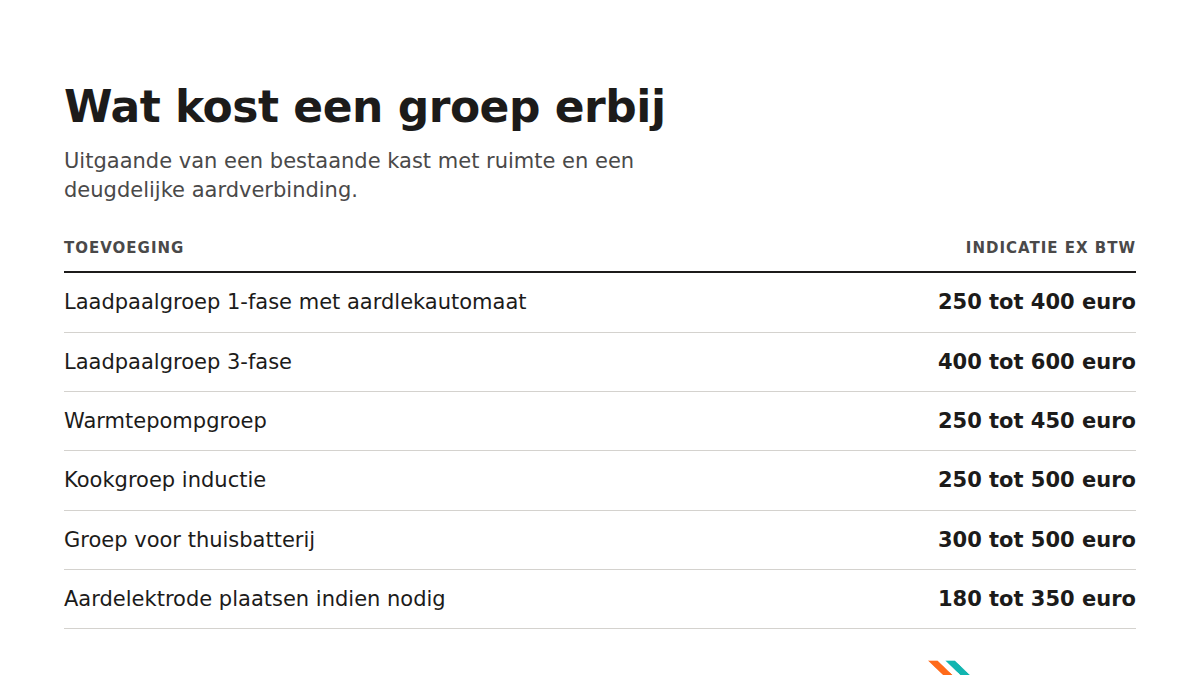
Excl. VAT, prices as of August 2026. Assuming an existing consumer unit with space.
| Addition | Indication |
|---|---|
| EV charger connection in the consumer unit | € 350 to € 795 |
| Installing a three-phase power supply | € 450 |
| Heat pump circuit | € 250 to € 450 |
| Induction cooking circuit | € 250 to € 500 |
| Circuit for a home battery | € 300 to € 500 |
| Type B RCD if needed | € 200 to € 350 extra |
| Fitting an earth electrode | € 180 to € 350 |
| Call-out charge | € 59,99 excl. VAT, same fixed rate nationwide |
If the consumer unit is full, it becomes a replacement and you are in a different order of magnitude. See consumer unit replacement and cost of consumer unit replacement.
Do it all at once if you can
This is the advice that saves you the most. Are you planning to get an EV charger and a heat pump and perhaps a battery within a few years? Then do the consumer unit properly in one go.
Having an electrician come three times means three call-out charges, three lots of setting-up time and three days without power. Fitting a roomy consumer unit once with four spare modules is almost always cheaper in the long run.
From my own work
At a house in Beek I came to add an EV charger circuit. When I opened the consumer unit there was only one module free. So I asked what else was planned. The answer: a heat pump next year, maybe a battery after that. In agreement with the customer I replaced the consumer unit there and then with a 36-module version. That day it cost € 900 more, but the two follow-up jobs are now both two-hour jobs instead of a full day.
When to call an electrician
Before you order the EV charger, heat pump or hob. The connected load of the appliance determines what needs to go in the consumer unit, and sometimes a different model is the cheaper solution.
Send a photo of your open meter cupboard, a photo of your main fuses and the type number of what you want to connect via WhatsApp. Then I know whether it fits. Or request a quote straight away.
Frequently asked questions
Can an EV charger go on an existing circuit?
No. Always its own final circuit with its own RCD protection.
Do I need to upgrade my connection for a heat pump?
Not always. It depends on the power input of the model and on what else runs at the same time. Work it out before you apply.
Can my induction hob run on less power?
Many hobs can be rewired to a lower total power or a different phase arrangement. That regularly saves an expensive connection upgrade. Check the manual or ask me.
How many modules does an extra circuit take?
With an RCBO one module on single-phase and four on three-phase. With a separate breaker one module, but then there must still be RCD capacity left.
What if my consumer unit is full?
Then it is a replacement or an add-on unit. With three or more extra circuits, replacing is usually the better choice.
Is an upgrade possible in my street?
Not everywhere. First do the grid congestion check on your postcode.
Further reading
Which consumer unit brand should you choose? Hager, Schneider, ABB and the rest
All brands are equally safe. The difference is whether you can still add a circuit in eight years' time, and that is exactly what nobody tells you.
Connecting an RCD: how it should be done and why it is not a DIY job
Where it sits in the chain, how it works and the neutral fault that explains nine out of ten RCDs that trip at random.
Meter cupboard dimensions: what fits and what are the requirements?
The standard sizes, how many modules really fit and the three things you need to measure before you order a bigger consumer unit.
Questions and comments
Ask your question below. Ask before 17:00 on a working day and you get an answer from Kevin himself the same day. No account needed, and your email address does not appear on the site.